Canada Passport Photo Guidelines for Infants: A Technical Guide
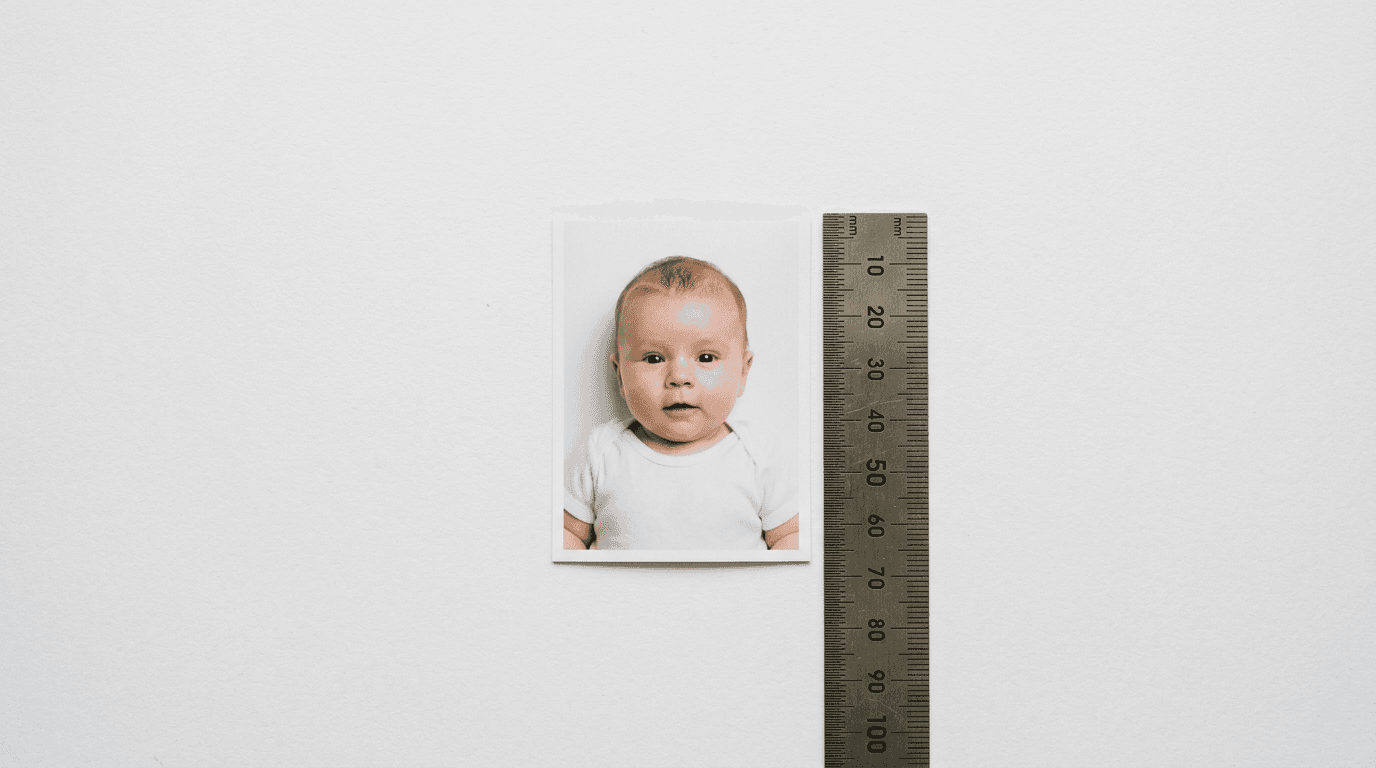
A guarantor staring at the back of a freshly printed 50x70 mm photograph, pen in hand, is the exact moment most infant travel documentation halts. The parent has managed to keep the baby's eyes open and mouth shut, but they realize there is no commercial photographer stamp on the back - a strict requirement that separates a Canada passport photo from almost every other international travel document. Unlike the two-by-two-inch standard heavily relied upon in the United States, Canadian passport authorities enforce a precise rectangular geometry combined with back-of-photo authentication rules that leave zero room for error. When securing travel documents for a newborn or toddler, understanding the biometric tolerances, physical dimensions, and specific rejection triggers of Canadian passport applications prevents weeks of processing delays.
Quick Summary
A Canadian passport photograph for an infant requires a 50x70 mm physical print with specific biometric proportions, distinct from the square layouts used in other North American jurisdictions. Securing approval hinges on mastering lighting, facial neutrality, and mandatory physical endorsements on the photograph's reverse side.
- Physical dimensions must strictly measure 50 mm in width by 70 mm in height.
- The infant's head size, from chin to crown, must fall precisely between 31 mm and 36 mm.
- The reverse side of one photo requires a guarantor's signature alongside the photographer's details.
- Shadows on the face, shoulders, or background are the primary cause for biometric rejection.
Table of Contents
- The Dimensional Lens: Canadian Sizing Versus Global Standards
- Biometric Facial Targeting for Infants
- The Illumination Problem: Background Contrast and Shadows
- The Guarantor Validation and Back-of-Photo Requirements
- Common Rejection Triggers for Infant Applications
- Digital Capture Mechanics: Resolution and Optical Distortion
- Canadian vs. US Infant Passport Photo Tolerances
- FAQ
- Recommended Reads
The Dimensional Lens: Canadian Sizing Versus Global Standards
The most critical distinction to understand when preparing Canadian passport photos is the dimensional geometry. Canada does not use the standard 2x2 inch (51x51 mm) square format common in other jurisdictions. Instead, the Canadian government requires a rectangular photograph measuring exactly 50 mm wide by 70 mm high. This elongated format is specifically designed to accommodate a larger vertical facial area while leaving adequate space at the top of the frame and below the chin for scanning equipment to register the subject's features without edge distortion.

For infants, achieving this dimension is uniquely challenging because the internal proportions - the biometric framing - must remain entirely accurate within that larger rectangle. The vertical height of the child's head, measured from the very bottom of the chin to the natural top of the head (the crown), must be between 31 mm and 36 mm. If the infant's head is tilted even slightly upward, the chin drops and the crown recedes, artificially lengthening the facial plane and causing the photograph to fail the physical template overlay used by passport officers. For parents navigating the Canada Baby Passport Photo Guide, understanding that the camera must be perfectly parallel to the infant's face is the first step in avoiding biometric rejection.
Furthermore, the framing must place the infant's face squarely in the center of the 50x70 mm rectangle. If the child is slouching in a car seat or being held at a slight angle, the centerline of the nose will offset from the centerline of the printed image. Passport scanning algorithms look for horizontal symmetry; an offset face triggers manual review, which frequently ends in rejection. This rigid dimensional requirement is why repurposing a photo meant for a different country rarely works.
Practical rule: Always position the camera lens exactly parallel to the infant's facial plane, maintaining a minimum distance of four feet (1.2 meters) to prevent spherical distortion from artificially bloating the nose or cheeks.
Biometric Facial Targeting for Infants
Government biometric systems evaluate human faces by mapping the distance between key anchor points: the pupils, the tip of the nose, the corners of the mouth, and the bottom of the chin. In adult photography, instructing the subject to maintain a neutral expression keeps these anchor points in their expected anatomical positions. With infants, enforcing a neutral expression is biologically and behaviorally difficult, yet the Canadian guidelines offer very little leniency for variations.
The most frequent biometric failure in infant Canadian photo passport submissions involves the mouth. The Canadian standard dictates that the subject's mouth must be entirely closed. For newborns, a relaxed jaw naturally drops open. If an infant's mouth is open wide enough to see the tongue or gums, the distance between the nose and the chin is artificially extended, corrupting the facial mapping algorithm. While some global authorities offer explicit exemptions for infants under six months regarding open mouths, the Canadian standard remains rigid. Parents must time the photograph for a moment when the infant is perfectly calm, well-fed, and resting with a closed jaw. If you are comparing this to the United States Baby Passport Photo Guide, you will notice that the US offers slightly more leeway for newborn expressions than Canada does.
Eye alignment presents the second major biometric hurdle. The infant's eyes must be open and looking directly at the camera lens. Strabismus (where the eyes do not properly align with each other) is common in newborns as their ocular muscles develop. However, if one eye is looking off-camera or is heavily hooded by a drooping eyelid, the software cannot map the interpupillary distance accurately. The subject must be actively engaged with the center of the camera lens, not looking at a parent waving a toy off to the side. Red-eye removal software cannot be used to correct reflection issues, as any digital alteration of the eye area immediately invalidates the photograph.
The Illumination Problem: Background Contrast and Shadows
The Canadian government requires that the background of the photograph be plain white or light-colored, with sufficient contrast between the background, the facial features, and the infant's clothing. This sounds simple but is technically demanding when capturing an infant who cannot sit up independently. When an infant is laid on their back on a white sheet, the ambient room lighting often casts harsh, directional shadows down the sides of their face or deeply under their chin.

Shadows are interpreted by facial recognition software as physical boundaries or contours. A dark shadow under the chin can trick the scanner into mapping the infant's jawline incorrectly, pushing the chin-to-crown measurement outside the mandatory 31-36 mm window. Similarly, shadows cast by the infant's ears or head onto the white background destroy the edge contrast necessary for the system to separate the subject from the backdrop. If the system cannot digitally isolate the head, the photograph is rejected.
Achieving flat, shadowless illumination requires diffused light from multiple sources. A single overhead room light is almost guaranteed to cause rejection. Natural, indirect window light, facing the infant evenly, is highly effective. However, parents must ensure that the light is not overly bright on one side, which causes a gradient across the face. Using a reliable US Baby Passport Photo Maker that incorporates AI processing can correct background discrepancies, but the initial illumination on the face must still be completely even. Overexposing the image to wash out shadows will bleach the infant's skin tones, which is another explicit rejection criteria in Canada.
The Guarantor Validation and Back-of-Photo Requirements
The most distinctive element of the Canadian application process is what happens on the physical reverse side of the printed photograph. Unlike many nations that have moved entirely to digital uploads or blank physical prints, Canada mandates strict documentation on the back of one of the two identical printed photos. This requirement frequently trips up families who assume that a high-quality digital capture is the final step.
One of the photos must bear the name and complete address of the photography studio or the entity that produced the image, along with the date the photo was taken. For parents using digital generation services, this information can be printed directly on the back of the photo paper or handwritten cleanly. However, sticking a printed label on the back is strictly prohibited by Passport Canada.
More importantly, this same photograph must be certified by an eligible guarantor. The guarantor must physically write: "I certify this to be a true likeness of (Infant's Full Name)," and then sign their name. The guarantor must be an adult who has known the applicant (or the parent, in the case of a newborn) for at least two years and holds a valid Canadian passport themselves. The ink used must be standard black or blue pen, and the writing must not press so hard that it debosses or damages the front of the photograph. The failure to secure this signature, or smudging the ink before it dries, renders the perfectly captured biometric image completely useless.
Common Rejection Triggers for Infant Applications
Understanding the exact mechanical reasons a passport size photo canada gets rejected allows applicants to self-audit before submission. Rejections rarely happen because a photo is generally "bad"; they happen because the photo violates a specific mathematical or procedural rule.
First, the visibility of support structures. When photographing a newborn, parents naturally try to hold the child's head upright. If a parent's hand, arm, or even a piece of their clothing is visible anywhere in the frame - even merely supporting the back of the neck - the photo will be rejected. The infant must appear entirely unsupported. If the infant is placed in a car seat draped with a white sheet, the edges of the car seat or the texture of the wrinkled sheet cannot intrude into the background space behind the child's head.
Second, digital alteration. Many smartphones now default to applying subtle "beauty filters" or HDR (High Dynamic Range) processing that artificially smooths skin textures or enhances the brightness of the eyes. Canadian passport authorities utilize forensic software to detect pixel manipulation. Any sign of digital retouching, even if it simply removes a temporary scratch on the baby's cheek or adjusts the color balance heavily, will trigger a rejection. The image must be a raw, accurate representation of the child. Services that back their generation with a 100% Refund Policy do so by strictly avoiding any alteration of the facial biometrics while adjusting the background strictly to compliance.
Third, glare on the skin. While infants do not typically wear glasses (a major source of glare in adult photos), their skin can reflect bright light, especially if a direct flash is used. A heavy flash creates hot spots - bright white areas of overexposure - on the forehead or the bridge of the nose. These hot spots destroy the pixel data in those areas, leaving the scanning software unable to read the skin texture or facial contour.
Practical rule: Never use an on-camera flash when photographing an infant for official documents; the rapid burst of light will startle the child, cause them to shut their eyes, and create illegal specular highlights on their skin.
Digital Capture Mechanics: Resolution and Optical Distortion
While the final submission for a Canadian passport requires physical prints, the initial capture is entirely digital. The mechanics of the camera lens dictate whether the resulting photograph will maintain true anatomical proportions. Most modern smartphone cameras utilize wide-angle lenses to capture more of a scene. When a wide-angle lens is brought too close to a subject's face - such as leaning in over a baby resting on a bed - it creates spherical distortion.
Spherical distortion causes objects closest to the lens (usually the nose and forehead) to appear disproportionately large, while the edges of the face (the ears and jawline) curve away and appear artificially small. The Canadian passport facial recognition software measures the distance between the ears and the width of the jaw. If these proportions are warped by a wide-angle lens, the photo fails the biometric threshold. To counteract this, the camera must be positioned further back, utilizing optical zoom (not digital zoom) to frame the subject, which compresses the facial features into an accurate representation.
The final image file must also possess the resolution necessary to print cleanly at 300 Dots Per Inch (DPI). If a low-resolution image is printed at the 50x70 mm size, the edges of the face will appear jagged or blurred (pixelation). The Canadian government explicitly requires that the photo be in sharp focus, clear, and possess high resolution. When scaling an image to print on specialized 4x6 photographic paper at a local pharmacy, verifying that the source file has not been compressed by sending it through a messaging app is a vital quality control step before consulting US & International Baby Passport Photo Requirements & Guides for final print layouts.
Canadian vs. US Infant Passport Photo Tolerances
| Specification | Canadian Passport Photo | US Passport Photo |
|---|---|---|
| Physical Dimensions | 50 mm wide x 70 mm high | 2x2 inches (51x51 mm) |
| Head Height (Chin to Crown) | 31 mm to 36 mm | 1 inch to 1 3/8 inches (25-35 mm) |
| Mouth Position | Strictly closed (rigidly enforced) | Closed, but slight leniency for newborns |
| Background | Plain white or light-colored | Pure white or off-white |
| Reverse Side Endorsement | Mandatory guarantor signature & photographer details | Blank (No writing allowed) |
| Facial Expression | Strictly neutral | Neutral, but difficult for infants |
FAQ
Do Canadian passport photos need to be printed on matte or glossy paper?
The Canadian government requires that passport photos be printed on high-quality photographic paper, which can be either matte or glossy. However, matte is strongly preferred as glossy paper can stick to the application forms or cause glare when scanned by the passport office.
Can I wear a hair bow or headband in a Canadian baby passport photo?
No. Hair accessories, large bows, or decorative headbands must be removed. The entire head, including the hairline and ears, should be as visible as possible without any obscuring items.
What if my infant cannot support their own head for the photo?
Place the infant lying flat on their back on a plain white sheet or blanket. Ensure no hands, arms, or rolled-up towels used for support are visible in the camera frame. The photograph must be taken from directly above to simulate a vertical posture.
Does the guarantor have to be present when the photo is taken?
No, the guarantor does not need to be physically present when the photograph is captured. They only need to physically sign and certify the back of the printed photograph after it has been produced.
Why was my baby's photo rejected for a lack of contrast?
A lack of contrast occurs when the infant's clothing, skin tone, or hair blends directly into the background without a clear boundary. Ensure the child is wearing a shirt that contrasts with the plain white background to create a definitive edge along the shoulders.