India Passport Photo Requirements: 2026 Specifications and Biometric Rules
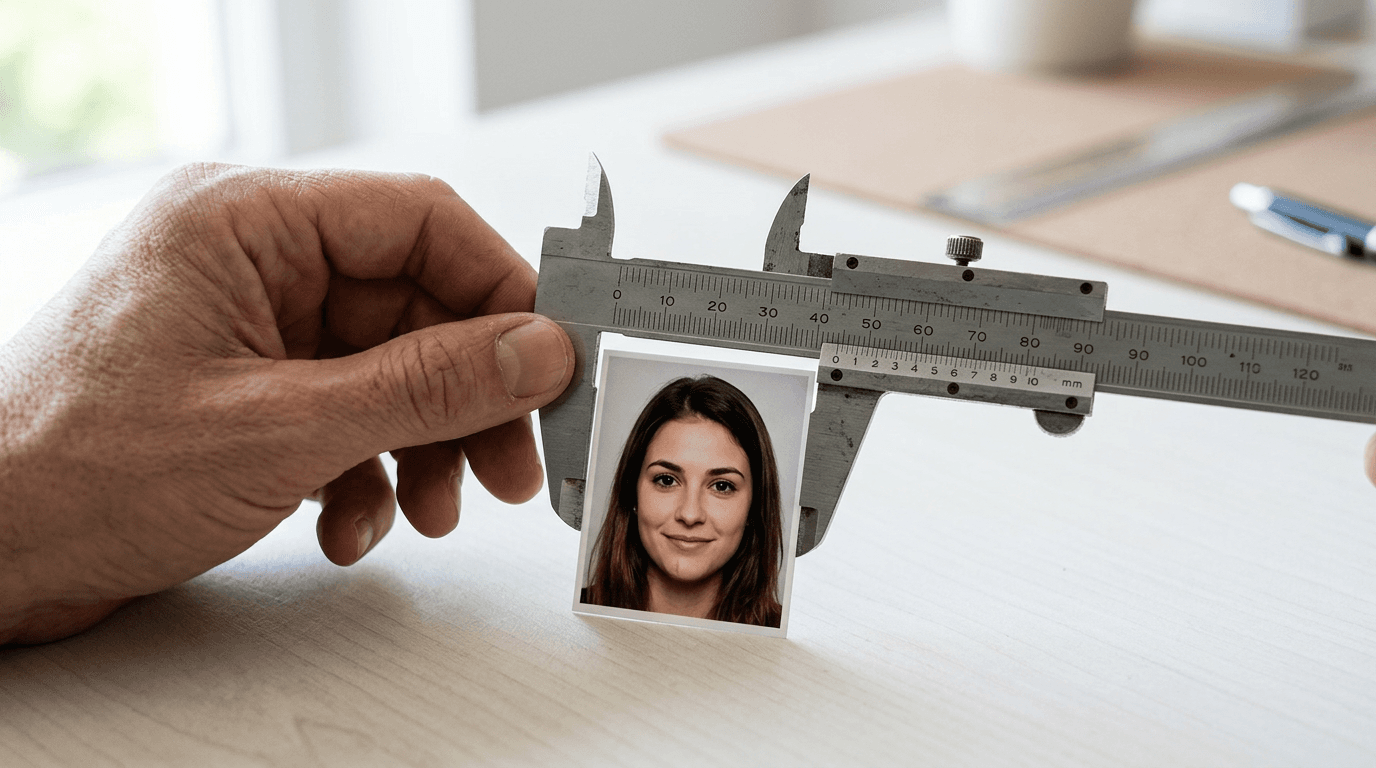
You open the envelope from the consulate, expecting your renewed passport, only to find a rejection letter stating your application is on hold. The culprit is rarely the paperwork; it is almost always the photograph. Indian passport and visa processing centers enforce strict biometric standards, and a shadow behind the ears or a head size that is two millimeters too small will trigger an automatic rejection. Understanding the exact India passport photo requirements before you submit your application prevents weeks of processing delays and the cost of starting over.
Quick Summary
Meeting the India passport photo requirements means adhering to strict biometric standards set by the Government of India for both physical and digital submissions. The specifications dictate exact dimensions, background color, and facial proportions to ensure automated facial recognition systems can process the image without manual intervention.
- Dimensions: Exactly 2 x 2 inches (51 x 51 mm) for physical prints.
- Head size: The head must measure between 1 inch and 1.375 inches (25 mm to 35 mm) from the bottom of the chin to the top of the hair.
- Background: Plain white or off-white with no shadows or patterns.
- Expression: Neutral expression with both eyes open and mouth closed.
- Recency: Taken within the last six months to reflect your current appearance.
Table of Contents
- Why Indian Consulates Reject Photos
- Exact Dimensions and Head Sizing
- Lighting, Background, and Contrast Rules
- Attire, Glasses, and Facial Expressions
- Infant and Baby Photo Exceptions
- Digital vs. Printed Specifications
- FAQ
- Recommended Reads
Why Indian Consulates Reject Photos
The distinction that organizes every rule in this guide is the difference between a good photograph and a compliant biometric data point. Indian passport photo specifications are not about aesthetics; they are designed to feed facial recognition algorithms. When an application is processed, software scans the image to map the distance between the eyes, the width of the nose, and the shape of the jawline.
If the background is too dark, the software cannot find the edge of your face. If you smile, your cheek muscles alter the shape of your eyes. If your head is tilted even slightly, the biometric map skews. Most rejections happen because applicants treat the requirement like a portrait rather than a technical scan. You must prioritize flat lighting, exact proportions, and high contrast over looking your best.
Exact Dimensions and Head Sizing
The physical size of the photograph is the first hurdle. The standard Indian passport size photo requirements mandate a square image measuring exactly 2 x 2 inches (51 x 51 mm). This is identical to the US passport photo size, which makes sourcing prints easier if you are applying from the United States.

However, the overall size is only half the requirement. The internal proportions are where most applicants fail. The head must be centered, and the distance from the bottom of the chin to the top of the hair (the crown) must be between 1 inch and 1.375 inches (25 mm to 35 mm). The eye level should be between 1.125 inches and 1.375 inches (28 mm to 35 mm) from the bottom edge of the photo. If the camera is too close, your face fills too much of the frame; if it is too far, your head is too small for the biometric scanner to read accurately.
Practical rule: Measure the printed photo with a physical ruler before submitting it. If the chin-to-crown distance is exactly 30 mm, you are safely in the middle of the acceptable range.
Lighting, Background, and Contrast Rules
Lighting must be even and flat. The goal is to eliminate all shadows on the face and the background. A common failure mode is using a single overhead light, which casts deep shadows under the eyes, nose, and chin. These shadows confuse biometric scanners, which interpret dark areas as physical features.
The Background Requirement
The background must be plain white or off-white. There can be no texture, no patterns, and no other objects in the frame. If you stand too close to the wall when taking the photo, your body will cast a shadow behind you, which is an immediate cause for rejection. Stand about two feet away from the background to allow light to fall behind you.
Contrast and Exposure
The image must have high contrast and sharp focus. Overexposed photos wash out facial features, while underexposed photos merge dark hair with the background. The skin tone must appear natural. Filters, beauty modes, and digital enhancements are strictly prohibited because they alter the biometric data.
Attire, Glasses, and Facial Expressions
What you wear and how you present your face directly impacts the scanner's ability to map your features. The rules here are absolute.
Clothing Choices
Wear dark or brightly colored clothing that contrasts sharply with the white background. If you wear a white shirt, your shoulders will blend into the background, making you look like a floating head. Uniforms are not permitted, except for religious attire worn daily. If you wear a head covering for religious reasons, it must not cast shadows on your face, and your full face from the bottom of the chin to the top of the forehead must be visible.
Glasses and Accessories
Glasses are a massive liability. Even if you wear prescription glasses daily, the Indian government strongly recommends removing them for the photo. Glare on the lenses, thick frames obscuring the eyes, or tinted lenses will result in rejection. If you must wear them for medical reasons, the frames cannot cover any part of your eyes, and there must be zero glare. It is always safer to remove them.
Facial Expression
You must maintain a neutral expression. Both eyes must be open, looking directly at the camera, and your mouth must be completely closed. A smile alters the shape of your face and will fail the biometric check.
Infant and Baby Photo Exceptions
Photographing infants for official documents is notoriously difficult, and the authorities offer slight leniency regarding expressions, but the core biometric rules remain. The baby must be the only person in the frame. You cannot hold the baby in a way that shows your hands or arms.
For newborns, the easiest method is to lay the child flat on their back on a plain white sheet. Ensure there are no wrinkles in the fabric. Alternatively, drape a white cloth over a car seat and strap the baby in. The baby's eyes must be open (though very young infants may have slightly closed eyes, it is best to catch them awake), and they should be looking generally toward the camera. Pacifiers, toys, and blankets covering the face are forbidden. If you are struggling with this process, reviewing a dedicated United States Baby Passport Photo Guide can provide techniques that apply equally to Indian specifications.
Digital vs. Printed Specifications
Depending on whether you are applying for an e-Visa or a physical passport renewal, you will need either digital files or physical prints. The core indian passport photo requirements remain the same, but the delivery format changes.
Digital Uploads
For online applications, the image must be in JPEG format. The file size must be between 10 KB and 300 KB. The dimensions must be a perfect square, typically 350 x 350 pixels minimum and 1000 x 1000 pixels maximum. The image cannot be compressed to the point of pixelation.
Physical Prints
Physical prints must be on high-quality photographic paper. Matte or glossy finishes are generally acceptable, but matte is preferred as it prevents glare when scanned at the processing center. The prints must not have any tears, creases, or smudges. Do not staple the photo to the application unless explicitly instructed, as the staple can damage the facial area.
| Specification | Physical Print | Digital Upload (e-Visa) |
|---|---|---|
| Dimensions | 2 x 2 inches (51 x 51 mm) | Min 350x350 pixels, Max 1000x1000 pixels |
| Format | High-quality photo paper | JPEG (.jpg) |
| File Size | N/A | 10 KB to 300 KB |
| Background | Plain white or off-white | Plain white or off-white |
| Head Size | 25 mm to 35 mm (chin to crown) | Proportional, centered |
FAQ
Can I wear makeup in my Indian passport photo?
Yes, light, everyday makeup is acceptable. However, heavy contouring or makeup that significantly alters your facial structure or skin tone will cause the biometric scan to fail.
What happens if my photo is rejected?
If your photo fails to meet the India passport photo specifications, your application will be placed on hold. You will receive a notification to submit new photographs, which delays the entire processing timeline.
Can I take the photo with my smartphone?
Yes, modern smartphone cameras have sufficient resolution. However, you must ensure the lighting is flat, the background is pure white, and the image is not distorted by a wide-angle lens. Do not use the front-facing 'selfie' camera, as it distorts facial proportions.
Do my ears need to be visible?
While it is highly recommended that both ears are visible to provide a clear outline of the face, it is not strictly mandatory unless your hair obscures the edges of your cheeks or jawline.