Navigating Biometric Standards: Vietnam, Taiwan, and Singapore Passport Photo Guidelines
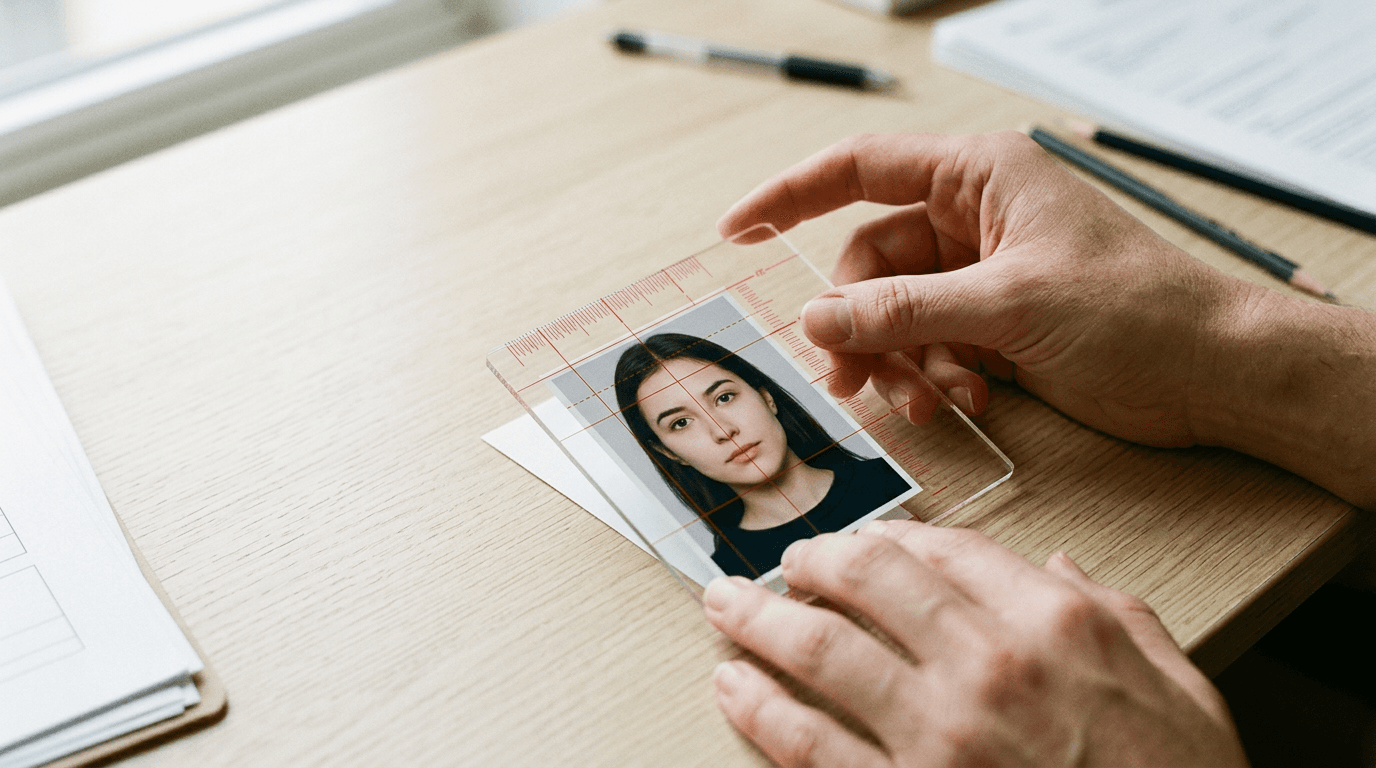
A parent submitting an infant's visa application for Southeast Asia often hands over a standard two-by-two inch print, only to watch the consular officer measure the head with a transparent plastic grid and reject the entire application. The assumption that the specifications listed in a United States baby passport photo guide will suffice globally is a critical error. Asian consular requirements operate on entirely different biometric scales, utilizing distinct aspect ratios, strict background color expectations, and exact millimeter mandates for facial feature positioning. This article explores the precise mechanisms and formatting rules necessary to meet vietnam passport photo requirements, alongside the rigid biometric constraints enforced by Taiwan and Singapore.
Quick Summary
Asian passport and visa applications require exact adherence to metric dimensions and biometric facial mapping that differ significantly from North American standards. Failing to match head-to-image ratios, incorrect aspect scaling during printing, or utilizing improper background contrast will result in immediate document rejection by border authorities.
- Vietnam mandates a strict 4x6 cm photograph with a 2:3 aspect ratio.
- Taiwan requires a 35x45 mm print, heavily regulating the chin-to-crown measurement to fall precisely between 3.2 cm and 3.6 cm.
- Singapore demands 400x514 pixel digital uploads with specific file size limits and matte physical prints.
- Printing digital photo sheets at retail locations often introduces auto-scaling errors that alter biometric measurements.
Table of Contents
- Navigating vietnam passport photo requirements
- Why Taiwan rejects standard travel images
- The strict biometric standards in Singapore
- Photographing infants for Asian travel documents
- Comparison of regional biometric specifications
- Where DIY editing and retail printing fail
- FAQ
- Recommended Reads
Navigating vietnam passport photo requirements
The core distinction for Vietnamese travel documents, whether applying for an electronic visa, a visa on arrival, or a direct consulate passport renewal, is the metric aspect ratio. Reviewing complete international baby passport photo requirements reveals that the Vietnamese government expects a portrait orientation that cannot be achieved by simply trimming down a standard square image.
The official vietnam passport photo size is strictly 4x6 cm (40x60 millimeters). When applicants attempt to repurpose a standard US 2x2 inch (51x51 mm) photograph by cutting off the sides, they invariably ruin the required proportions. Removing 11 millimeters from the width of a square photo alters the visual framing, often leaving the subject's shoulders severed or failing to provide the required blank space above the head.
Vietnamese immigration systems also require the face to occupy the vast majority of the total image area. The background must be a solid, pure white. While some older guidelines for visa-on-arrival applications occasionally accepted light blue backgrounds, modern digital border checkpoints in Hanoi and Ho Chi Minh City standardize on white to optimize the contrast against the traveler's hair and facial edges. Any gradients, shadows cast on the backdrop, or off-white gray tones introduced by poor indoor lighting will cause the automated scanning software to misread the biometric markers.
Why Taiwan rejects standard travel images
The Taiwan Bureau of Consular Affairs (BOCA) enforces some of the most exacting standards in the region. The primary cause of rejection for these applications is not the overall paper size, but the internal mapping of the facial features.
Specific taiwan passport photo requirements dictate a physical dimension of 35x45 mm. However, the true hurdle lies in the chin-to-crown mandate. The vertical distance from the bottom of the chin to the top of the head (excluding hair volume) must measure between 3.2 cm and 3.6 cm. Because the entire photo is only 4.5 cm tall, a 3.6 cm head leaves a maximum of 9 millimeters to be split between the space above the head and the space below the chin. If the head measures 3.1 cm, it is rejected for being too small; if it measures 3.7 cm, it is rejected for lacking sufficient overhead clearance.
Furthermore, Taiwan requires absolute visibility of specific facial landmarks. The ears must be clearly visible, which often requires applicants to tuck their hair behind their ears before the shot. Eyebrows cannot be obscured by bangs. The subject must maintain a neutral expression with the mouth entirely closed - no teeth may be visible. For infants, whose necks are short and shoulders sit high, framing a 3.2 cm head while keeping the ears visible and the mouth completely shut requires exact camera positioning and often dozens of attempts.
The strict biometric standards in Singapore
The Immigration & Checkpoints Authority (ICA) of Singapore relies heavily on automated digital verification before a human officer ever reviews an application. If the underlying data of the image file does not meet the necessary technical parameters, the digital portal will immediately reject the upload.
Digital singapore passport photo requirements specify an exact pixel dimension of 400 pixels wide by 514 pixels tall. The digital file size is heavily restricted, usually capped under 2MB, and must be in a standard JPEG format utilizing the sRGB color space. When parents photograph their children and share the image via messaging apps like WhatsApp or iMessage before uploading, the apps strip the EXIF data and compress the file, introducing digital artifacts around the hairline that the ICA's software interprets as image manipulation.
For physical submissions, the print must be 35x45 mm. Crucially, Singapore demands a matte finish for printed photos. Glossy photo paper reflects the intense light of the consulate's flatbed scanners, creating blown-out white spots on the subject's forehead or cheeks. The ICA software perceives these reflections as missing biometric data, leading to an automatic failure. Lighting during the initial photograph must be entirely flat and uniform, preventing any distinct shadows across the bridge of the nose or behind the ears.
Photographing infants for Asian travel documents
Capturing an image of a newborn or infant that meets these strict international standards introduces physical challenges that adult photography does not face. Infants lack the neck strength to sit upright in a chair against a wall, making standard studio setups useless.

The most reliable mechanical approach is to lay the infant flat on their back on a smooth, bright white sheet or poster board. However, this creates a secondary problem: overhead room lighting casts a dark shadow directly under the baby's chin and around the sides of the head. According to standard help center documentation for digital processing, heavy shadows merge the jawline with the neck in the final two-dimensional image, preventing the facial recognition software from identifying where the chin ends.
Parents photographing from above must use natural, diffused daylight from a nearby window to wash out harsh overhead shadows. Furthermore, the choice of camera lens is critical. Default smartphone cameras use a wide-angle lens (typically 24mm to 26mm equivalent). When held close to a baby's face, a wide-angle lens distorts the geometry of the subject - enlarging the nose, receding the ears, and foreshortening the forehead.
Practical rule: Always use your smartphone's 2x or telephoto lens (a 50mm equivalent or higher) and step further back when photographing an infant from above. This flattens the optical distortion, preserving the exact chin-to-forehead ratio required by biometric scanners.
Comparison of regional biometric specifications
Understanding the differences between these Asian jurisdictions requires comparing their exact numerical constraints side by side. Reviewing biometric platform information clarifies how automated tools must adjust cropping algorithms depending on the target destination.
| Destination | Physical Size | Head Size Requirement | Background Color | Notable Rule |
|---|---|---|---|---|
| Vietnam | 40x60 mm | 70-80% of image height | Solid White | Rectangular 2:3 aspect ratio |
| Taiwan | 35x45 mm | 32mm to 36mm | Pure White | Ears and eyebrows must be visible |
| Singapore | 35x45 mm | 25mm to 35mm | White | 400x514px for digital; Matte finish for print |
| USA (Reference) | 51x51 mm (2x2") | 25mm to 35mm | White or Off-White | Square 1:1 aspect ratio |
The table demonstrates why a one-size-fits-all approach fails. A head measuring 30mm perfectly satisfies both the United States and Singapore, but will be outright rejected by Taiwan for being 2mm too small.
Where DIY editing and retail printing fail
When applicants attempt to format their own photos, the failure point usually occurs during the transition from digital file to physical paper. Local retail pharmacies like CVS or Walgreens print on standard 4x6 inch (102x152 mm) photographic paper. To get a 35x45 mm or 40x60 mm passport photo out of a retail printer, the digital file must be placed onto a 4x6 inch digital canvas at exactly 300 DPI (dots per inch).
The mechanical failure happens at the kiosk interface. Accepting standard service terms and conditions at retail print kiosks usually means acknowledging the software's default setting, which is "Fit to Page" or "Borderless Printing." To prevent white edges, the printer artificially enlarges the submitted image by 3% to 5%.
If you place a perfectly measured 35x45 mm Taiwanese passport photo onto a 4x6 layout, and the printer scales it up by 4%, the meticulously calculated 35mm head size expands to 36.4mm. It instantly breaches Taiwan's strict 3.6 cm maximum limit, turning a perfectly edited digital file into a useless piece of paper.
Practical rule: Instruct the retail photo clerk to print your 4x6 inch digital template at exactly 100% scale with zero border cropping, ensuring the biometric dimensions remain mathematically pure.
Navigating these exact tolerances manually requires a deep understanding of image resolution, canvas sizes, and optical scaling. Using an automated service backed by a 100% refund policy for compliance rejections shifts the financial and logistical risk away from the applicant, ensuring the underlying mathematics of the image remain intact from the camera lens to the consular desk.
FAQ
What is the exact vietnam passport photo size?
The mandatory dimension is 40x60 millimeters (4x6 cm), creating a portrait 2:3 aspect ratio. A standard 2x2 inch square photo cannot be used or cropped to meet this requirement without compromising the necessary facial framing.
Do infants need to keep their eyes open for Taiwanese and Singaporean documents?
Yes. Both Taiwan and Singapore require the infant's eyes to be open and clearly visible. While minor allowances are sometimes made for newborns under a few weeks old regarding completely neutral expressions, the eyes must be open to satisfy biometric mapping.
Can I submit a 2x2 inch photo for a Singapore visa?
No. Singapore requires a 35x45 mm physical print for paper applications, or a strictly formatted 400x514 pixel digital image for online portals. Submitting a 2x2 inch print will result in rejection.
How do I avoid shadows when photographing a baby from above?
Place the infant flat on a white sheet in a room with strong, indirect natural daylight coming from a window. Turn off overhead electrical lights, which cast shadows downward beneath the chin, and shoot from directly above using a 2x optical zoom to avoid casting your own shadow over the subject.