Navigating German Passport Photo Requirements: 6 European Standards
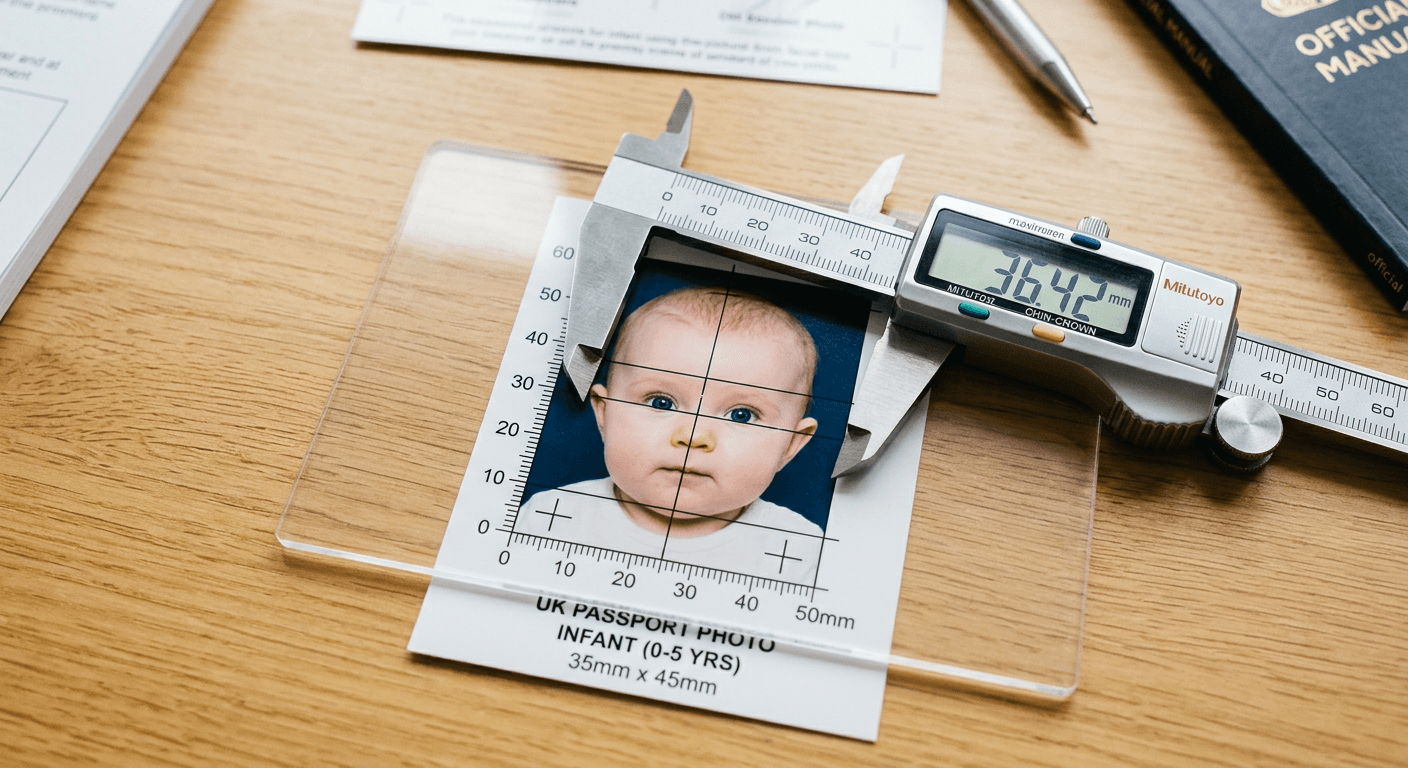
A parent hands an envelope to the consulate clerk on a Tuesday morning. The clerk feeds the printed image into the scanner, the biometric evaluation software throws a red geometric box over the infant's face, and the passport application is immediately suspended. The issue is rarely the baby's expression. Instead, it is a two-millimeter shadow under the chin that causes the software's edge-detection algorithm to fail. While the overarching framework for travel documents comes from the International Civil Aviation Organization (ICAO), individual national systems apply wildly different failure thresholds. Navigating german passport photo requirements, for instance, means understanding a strict dimensional grid that penalizes focal distortion. "The photo did not work" is not a diagnosis. European biometric systems reject images for distinct mechanical reasons - shadow gradients, incorrect background tint, optical distortion, and pupil misalignment - and each requires a specific correction before you try again.
Quick Summary
European biometric systems enforce strict geometric and contrast standards that frequently trigger automatic rejections for DIY applicants. While the base format is uniformly 35 by 45 millimeters, individual national software interprets head positioning, background tones, and shadow thresholds differently.
- The French system rejects pure white backgrounds, requiring light gray or blue to calibrate skin tones.
- Dutch standards enforce strict horizontal ear-to-ear measurements to detect camera lens distortion.
- Smartphone wide-angle lenses stretch facial geometry, failing the Polish and German grid checks.
- Shadow beneath an infant's chin is the leading cause of biometric edge-detection failures across the continent.
Table of Contents
- German Passport Photo Requirements Set the Baseline
- Diagnosing Italian and French Compliance Failures
- Background Tolerances in Greece and Poland
- The Strict Grid of Dutch Biometrics
- Comparison Table: European Biometric Photo Specifications
- How to Control Lighting and Geometry at Home
German Passport Photo Requirements Set the Baseline
The German Biometrietauglichkeit (biometric suitability) standard is the most rigidly applied geometric grid in Europe. When a photo is scanned at a German consulate, the system drops an overlay onto the image to measure vertical proportions. The core requirement mandates that the face - measured from the tip of the chin to the crown of the head, excluding hair - must occupy between 70 and 80 percent of the total image height. In absolute terms on a printed photo, this translates to exactly 32 to 36 millimeters.
This vertical measurement fails frequently when parents take photos with smartphones held too close to the subject. A smartphone's wide-angle lens distorts the center of the image, elongating the nose and pushing the ears back, which alters the software's calculation of the chin's termination point. Furthermore, the German software specifically looks for sharp contrast at the jawline. If the lighting creates a soft shadow that blends the chin into the neck, the edge-detection algorithm cannot establish the bottom coordinate, resulting in an automatic rejection.
There is a crucial exception for younger applicants outlined in any comprehensive Germany Baby Passport Photo Guide. For infants and children under the age of 10, the German authorities relax the lower bound of the face height. The head may measure between 22 and 36 millimeters (50 to 80 percent of the image). To check your own photo before submission, take a physical ruler to the printed image: if the distance from the chin to the top of the skull is 38 millimeters, you have zoomed in too much and the application will fail.
Diagnosing Italian and French Compliance Failures
While the italian passport photo size is universally set at 35 by 45 millimeters, Italian consular software is aggressively sensitive to digital noise and white balance. Italian applications often fail at the scanning stage because the image resolution drops below the mandatory 300 DPI (dots per inch) threshold during the cropping phase. When an applicant prints a low-resolution photo on standard inkjet paper, the scanner picks up the dithering - the microscopic grid of ink dots - rather than a continuous tone. The software interprets this dot matrix as facial texture and rejects the image. To verify this, look at the subject's eyes in the printed photo under a bright light; if the pupils look jagged or pixelated rather than perfectly round, the photo will fail the Italian scan.
Across the border, the French system introduces a completely different failure mode based on background tint. A pure white background is the most common reason french passport photos are rejected at the consulate. The French biometric algorithm relies on the background color to establish a baseline white balance for reading skin tones. If the background is stark white (RGB 255, 255, 255), the scanner underexposes the subject's face to compensate, rendering light skin gray and dark skin completely featureless. The French standard explicitly requires a light gray or light blue background. You can test your setup by placing a standard piece of white printer paper next to your subject's head; in the resulting image, the background must appear noticeably darker and cooler than the paper.
Background Tolerances in Greece and Poland
The Greek biometric framework focuses heavily on the margins of the photograph. When framing greek passport photos, the top margin - the empty space between the highest point of the subject's head and the physical edge of the cut photograph - must sit precisely between 3 and 5 millimeters. If a parent crops an infant's photo too tightly, leaving only 1 millimeter of space, the consular cropping tool will slice into the subject's hair, triggering an immediate geometric failure. The check here is simple: ensure a visible, unshadowed band of background color remains above the head on the final 35 by 45 millimeter print.
The algorithm scanning a polish passport photo relies heavily on pupil alignment to establish the horizontal axis of the face. The software draws a straight line between the center of both pupils; if this line is tilted by more than 5 degrees, the image is flagged for improper posture. For adults, this is easily corrected, but infants frequently lack the neck strength to hold their heads perfectly level. While Polish authorities allow infants under one year to have their eyes closed, if the eyes are open, the software is unforgiving about flash reflection. A single white pixel of glare over the pupil obscures the iris pattern and breaks the alignment check.
Practical rule: Place a rolled white towel under an infant's neck, hidden beneath their clothing, to force the chin upward and level the eyes; a downward tilt obscures the neck line and causes the biometric software to blend the jaw into the chest.
The Strict Grid of Dutch Biometrics
The dutch passport photo requirements operate on a highly specific framework known as the Photomatrix Model 2020. Unlike systems that only measure the vertical height of the head, the Dutch software applies an 18-element grid that cross-references horizontal facial proportions. The defining metric is the width of the face, measured from ear to ear, which must fall exactly between 16 and 20 millimeters.
This horizontal requirement exposes the most common flaw in DIY photography: improper focal distance. When a camera is held closer than 1.5 meters to the subject, optical distortion narrows the appearance of the face while enlarging the nose. A photo might perfectly meet the vertical 32-millimeter height requirement, but measure only 14 millimeters across the ears due to lens distortion. The Dutch system interprets this as an altered biometric profile and rejects the application.
To pass the Dutch matrix, the mechanical fix happens behind the camera. The photographer must stand at least 1.5 meters away and use the optical zoom to fill the frame, compressing the facial features into an accurate orthographic projection. Before submitting a Dutch application, lay a ruler horizontally across the printed face: if the distance between the visible edges of the ears is less than 16 millimeters, the focal length was too short, and the image must be retaken.
Comparison Table: European Biometric Photo Specifications
| Country | Standard Format | Adult Face Height | Background Rule | Infant Exceptions |
|---|---|---|---|---|
| Germany | 35 x 45 mm | 32 - 36 mm | Light gray or white | Face height 22 - 36 mm (under 10 years) |
| Italy | 35 x 45 mm | 32 - 36 mm | White | Relaxed posture rules, eyes must be open |
| France | 35 x 45 mm | 32 - 36 mm | Light blue or gray only | Closed eyes permitted under 1 year |
| Greece | 35 x 45 mm | 31 - 35 mm | White or off-white | Top margin must be precisely 3 - 5 mm |
| Poland | 35 x 45 mm | 31 - 36 mm | White | Closed eyes permitted under 1 year |
| Netherlands | 35 x 45 mm | 26 - 30 mm | Light gray, pale blue, or white | Face width must be 16 - 20 mm |
How to Control Lighting and Geometry at Home
Producing a compliant photo at home requires separating the subject from the background, both literally and photographically. When an infant is placed directly against a sheet on a bed, the lighting hits both the subject and the background at the exact same intensity. This creates deep, sharp drop-shadows immediately behind the ears and neck. Biometric software reads these shadows as physical extensions of the head, artificially inflating the face width and triggering a rejection.
The mechanical solution is distance. Move the subject at least 30 centimeters away from the backdrop. For an infant, this means placing them in a car seat covered with a taut, untextured gray or white blanket, rather than laying them flat on the floor. Position the setup facing a large window that provides indirect natural light. Direct sunlight casts hard shadows under the nose and chin, which destroys the edge-detection algorithm's ability to locate the bottom of the face.
Once the lighting is even, disable your camera's flash. A flash creates a specular highlight on the forehead and causes the pupils to constrict, both of which are grounds for rejection across the EU. Step back approximately 1.5 meters from the subject and use a 2x or 3x optical zoom. This specific distance compresses the facial features, ensuring the nose does not obscure the cheekbones and that both ears are equally visible to the camera. Before you commit to printing, compare your digital file against the standards listed in US & International Baby Passport Photo Requirements & Guides. Ask three diagnostic questions: Is the background entirely free of wrinkles and texture? Are both ears equally visible on the horizontal plane? Is the transition from the bottom of the chin to the top of the neck defined by a sharp, crisp line rather than a gradual shadow?
FAQ
Do infants need their eyes open for European passports? It depends on the country and the age of the child. France and Poland allow infants under one year to have their eyes closed, recognizing the difficulty of keeping a newborn awake. However, Italy and Germany generally require open eyes for all ages, though they will overlook a lack of direct eye contact with the lens for babies.
Can I use a pure white background for all EU countries? No. While a white background is accepted by Germany, Italy, and Poland, the French biometric system explicitly prohibits pure white backgrounds. Submitting a photo with a stark white backdrop to a French consulate will result in an automatic rejection because it throws off the software's skin tone calibration.
What is the standard European passport photo size? The baseline dimensions for printed European passport photos are 35 millimeters in width by 45 millimeters in height. However, the internal geometry - how much of that 35x45mm rectangle the face actually fills - varies significantly depending on whether you are applying under Dutch, German, or Greek standards.
How recent must a baby's passport photo be? European regulations require the photograph to reflect the applicant's current appearance, uniformly defined as being taken within the last six months. For newborns whose appearance changes rapidly, consulates often demand a photo taken within the last 30 days to ensure accurate border identification.