Navigating Schengen Visa Passport Photo Requirements for 2026
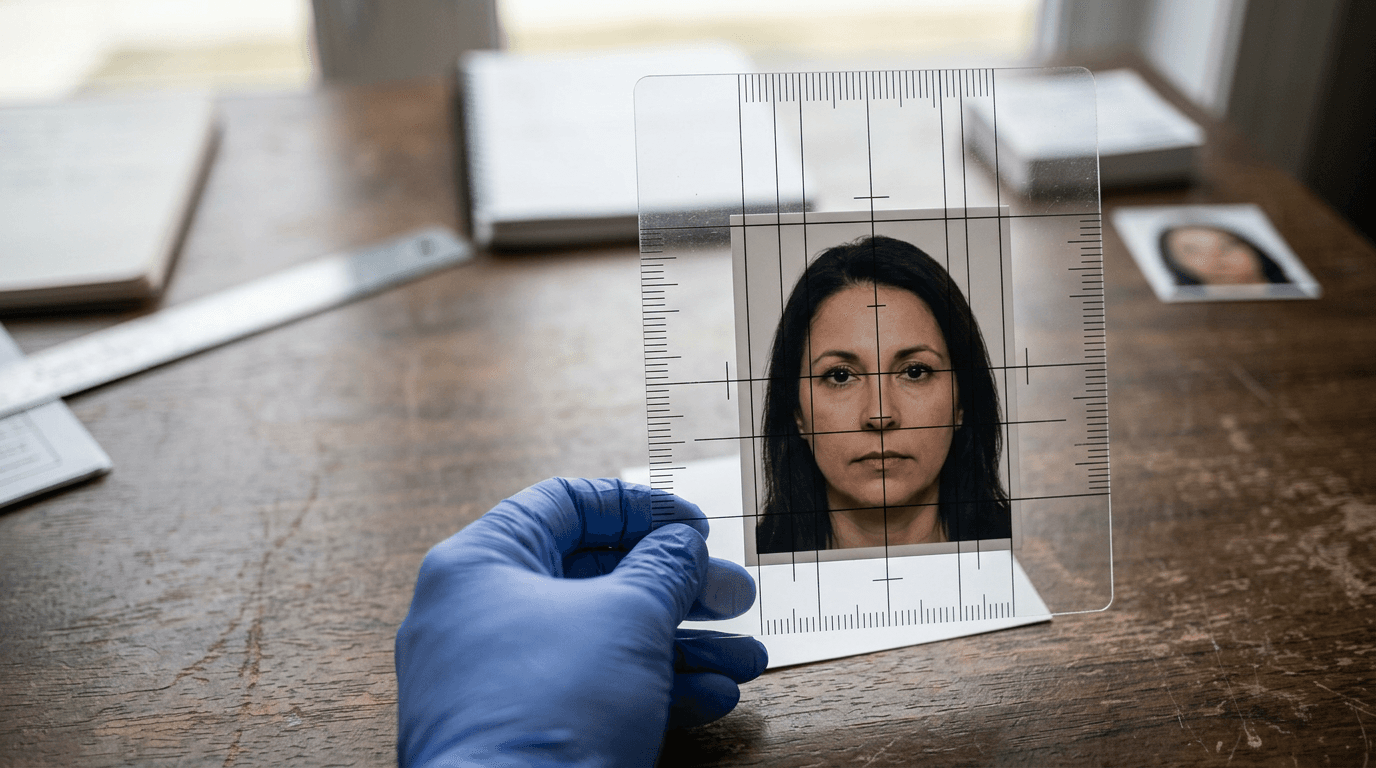
You are standing at the consular processing window, your dossier neatly organized, only for the clerk to place a transparent plastic template over your application. Within seconds, they slide the paperwork back under the glass. The chin-to-crown measurement on your image is two millimeters short of the biometric standard. Your application is rejected before it even reaches a visa officer. Getting the schengen visa passport photo requirements exactly right is not about capturing a flattering likeness; it is about providing a precise topographical map of a face that a machine can read.
Quick Summary
A Schengen visa application requires a biometric photograph measuring exactly 35x45mm, formatted to comply with ICAO Document 9303 standards. The image must provide a highly specific map of the applicant's facial features to pass automated border control systems.
- Dimensions must strictly adhere to 35mm in width and 45mm in height.
- The face must dominate the portrait, taking up the bulk of the total image area.
- The chin-to-crown measurement must fall between 32mm and 36mm.
- Backgrounds must be uniform, untextured, and typically light grey to provide edge contrast.
- Infants are subject to the same dimensions, though consulates allow minor leniency regarding eye contact and posture.
Table of Contents
- What Defines the Biometric Standard for Schengen Applications?
- How Scanners Evaluate Facial Topography
- Technical Specifications That Trigger Immediate Rejections
- Clothing, Glasses, and Headwear Constraints
- Formatting the passport size photo for schengen visa Applications
- Managing Infant Posture and Alignment Constraints
- Background Interference and Shadow Mechanics
- Navigating the Digital vs Physical Submission Gap
- Where Retail Photo Centers Miss the Mark
- FAQ
- Recommended Reads
What Defines the Biometric Standard for Schengen Applications?
The 29 European countries comprising the Schengen Area standardize their travel documentation around the guidelines published by the International Civil Aviation Organization (ICAO). When you submit an application, the consular staff does not simply look at the photograph to confirm it is you. They scan the image into a biometric database.
This system relies on standardized facial mapping. The software identifies the center of the eyes, the tip of the nose, and the corners of the mouth. It measures the distances and angles between these nodal points to create a unique biometric template. If the initial photograph is improperly scaled, poorly lit, or incorrectly cropped, the software cannot calculate these distances accurately. The rejection is automated.
Understanding this mechanism changes how you must approach the task. You are not taking a portrait; you are capturing raw data. Every rule regarding lighting, background, and head size exists to ensure the algorithm can establish a baseline measurement. This is why checking the specific guidelines for a Germany baby passport photo or any other member state always returns to the exact same core ICAO requirements.
How Scanners Evaluate Facial Topography
Biometric scanners rely on shadows and highlights to understand the three-dimensional depth of a face from a two-dimensional image. This is where lighting becomes a critical failure point.
If you use a direct flash, you flatten the topography of the face. The bridge of the nose disappears into the cheeks, and the depth of the eye sockets is erased by harsh, forward-facing light. Without these subtle shadows, the scanner cannot calculate the depth of the facial features. Conversely, if the light source comes from one side, it casts a shadow across half the face, moving the perceived location of the nose or jawline.
The optimal lighting setup uses soft, diffused light striking the face evenly from both sides. This creates a flat, even exposure that preserves the natural micro-shadows defining the facial structure without creating hard geometric shadows that confuse the edge-detection software. You can test your own image by looking at the bridge of the nose: if there is a distinct, sharp shadow on one side, or if it is entirely washed out and indistinguishable from the cheeks in tone, the photo will likely fail.
Technical Specifications That Trigger Immediate Rejections
Producing a compliant passport photo for schengen visa processing requires absolute precision. Consulates use transparent overlays with printed bounding boxes to verify dimensions before the application is even accepted for processing.

Precision Measurements and Bounding Boxes
The external dimensions must measure exactly 35 millimeters in width and 45 millimeters in height. Within that frame, the face itself must dominate the photograph, taking up the vast majority of the total area.
This translates to a strict vertical measurement: the distance from the bottom of the chin to the top of the head (the crown, not the top of the hair) must be between 32mm and 36mm. If the head is smaller than 32mm, the face is too far away, and the scanner cannot extract enough detail from the eyes. If the head is larger than 36mm, the subject is too close to the lens, and the algorithm risks cropping out the top of the head or the jawline entirely.
Background Contrast and Edge Detection
The background must be completely uniform and devoid of patterns, shadows, or secondary objects. Furthermore, it must provide sufficient contrast to the applicant's hair and skin tone.
While white is commonly requested in North America, many European consulates prefer a light, neutral grey. This preference exists because pure white backgrounds often cause modern camera sensors to underexpose the face in an attempt to balance the image. Additionally, if the applicant has very pale skin, white hair, or is wearing a white garment, a pure white background prevents the edge-detection software from finding the physical boundaries of the applicant's head and shoulders.
Practical rule: Never attempt to digitally remove and replace a background using basic painting or erasing tools; manual masking leaves jagged pixel artifacts along the hair and jawline that biometric security scanners immediately flag as fraudulent manipulation.
Clothing, Glasses, and Headwear Constraints
What you wear dictates how the scanner isolates your face from the rest of the image. The software must find a clear distinction where the chin ends and the neck begins, and where the shoulders separate from the background.
Heavy turtleneck sweaters, scarves, or high-collared jackets that obscure the jawline will cause a rejection. The software needs to locate the bottom of the chin to establish its baseline vertical measurement.
Eyewear should be removed entirely. While some consulates theoretically permit prescription glasses if the frames are exceptionally thin and the lenses produce zero glare, the risk of rejection is disproportionately high. Even a minor reflection from a studio light on the lens can obscure the pupil, rendering the interpupillary distance impossible to measure. Tinted lenses or transition lenses that have darkened slightly under bright lights are outright forbidden.
Headwear is strictly prohibited unless worn for religious or medical reasons. If an exemption applies, the head covering must be adjusted so that it casts absolutely no shadows on the face, and it must sit far enough back to expose the entire facial structure from the bottom of the chin to the top of the forehead. Both edges of the face must remain clearly visible.
Formatting the passport size photo for schengen visa Applications
A frequent error among North American applicants is attempting to reuse existing documentation photos. A passport size photo for schengen visa processing uses an entirely different dimensional standard than those used in the United States. Submitting a standard 2x2 inch square photo to a European consulate guarantees a rejection.
| Specification | Schengen Visa Standard | US Passport Standard |
|---|---|---|
| Overall Dimensions | 35mm x 45mm | 51mm x 51mm (2x2 inches) |
| Aspect Ratio | Portrait rectangle | Perfect square |
| Face Coverage | 70% to 80% of image area | 50% to 69% of image area |
| Head Size (Vertical) | 32mm to 36mm | 25mm to 35mm |
| Background Color | Light grey or pure white | Pure white or off-white |
Because the European format is a portrait rectangle with a much higher face-to-image ratio, you cannot simply trim the edges off a US square photo to make it fit. Cutting a 51x51mm photo down to 35x45mm will result in a head size that violates the 32-36mm chin-to-crown requirement.
This incompatibility is why consulting dedicated US and international baby passport photo requirements is necessary before attempting to format images for cross-border travel.
Managing Infant Posture and Alignment Constraints
Capturing biometric data for an adult requires simple instructions: stand still, look forward, close your mouth. Gathering the exact same biometric data from a three-month-old infant is a mechanical challenge.
The algorithm still requires a straight-on view of the face. The camera must capture both ears equally, meaning the head cannot be tilted to the left or right, nor can it be pitched forward or backward. For infants lacking the neck strength to hold their head upright, this creates a logistical hurdle.
Sitting the child in a bouncer or highchair frequently fails. The fabric is rarely a uniform light grey, the harness straps obscure the shoulders, and the child's head naturally slumps forward, hiding the neck and burying the chin into the chest. This posture ruins the critical chin-to-crown measurement.
Practical rule: Photograph an infant lying flat on their back on a plain white or light grey sheet in natural daylight, positioning yourself directly above them, to naturally align their spine and expose their chin without requiring physical support.
Background Interference and Shadow Mechanics
When photographing an infant, the introduction of foreign objects into the frame is the leading cause of rejection. The biometric scanner cannot differentiate between a parent's hand supporting the baby's neck and a physical anomaly on the applicant's body.
No hands, arms, or fingers may be visible anywhere in the frame. No pacifiers or toys can obscure the mouth or the jawline. Even if the parent's hand is only visible in the bottom corner of the image, far from the face, the photo violates the requirement for a uniform background.
Shadows present a similarly severe issue when an infant is lying down. If the overhead light is too directional, the baby's head will cast a deep, hard-edged shadow directly onto the sheet beside their ear. To the edge-detection software, this shadow registers as a continuation of the head, artificially widening the facial structure and corrupting the algorithm's calculations.
Navigating the Digital vs Physical Submission Gap
While many border systems are fully digitized, the application process for a Schengen visa often still requires submitting physical, printed photographs attached to the paper dossier.
Generating a visa passport size photo digitally is only half the process; rendering it onto physical paper introduces new failure points. The image must be printed at a minimum resolution of 300 Dots Per Inch (DPI). If the resolution drops lower, the edges of the facial features become pixelated, and the scanner will reject the image due to insufficient clarity.
The choice of paper matters heavily. Consulates mandate high-quality photographic paper, typically specifying a weight of at least 250 gsm. Furthermore, matte finishes are significantly safer than glossy finishes. Glossy paper tends to reflect the harsh overhead lighting inside the consulate's scanning equipment, creating hot spots over the face that obscure the underlying biometric data.
To bridge this gap successfully without specialized home equipment, you must format the 35x45mm images onto a standard 4x6 inch digital template. This allows the file to be processed by standard commercial printers without the kiosk software automatically resizing or stretching the crucial 32-36mm head measurements to fit the paper.
Where Retail Photo Centers Miss the Mark
Many applicants rely on local pharmacies or retail shipping centers to handle their application imagery. While these venues are functional for standard adult documentation, they frequently fail when confronted with complex biometric standards or uncooperative subjects.
Retail clerks operate in environments optimized for speed, not compliance. The lighting in a pharmacy aisle consists of mixed-temperature fluorescent tubes that cast green or yellow hues and harsh shadows downward. The camera equipment is usually a basic point-and-shoot tethered to a fixed backdrop that does not extend to the floor.
This setup makes capturing an infant nearly impossible. The clerk cannot lay the child down, and attempting to hold the infant upright in front of the drop-screen introduces parent hands and irregular shadows. Furthermore, the retail software is almost universally hardcoded to crop for the United States baby passport photo guide specification of 2x2 inches.
When a clerk attempts to force a European 35x45mm framing using software designed for a 51x51mm US format, the crop invariably destroys the facial proportion ratios. This is why securing a 100% refund policy on formatting services is vital when preparing cross-border documentation; the structural differences between national requirements leave no room for approximation.
FAQ
Can I use my US passport photo for a Schengen visa application?
No. The US passport photo is a 2x2 inch (51x51mm) square, whereas the Schengen visa requires a 35x45mm portrait rectangle. Trimming the US photo will ruin the required biometric head proportions.
Do infants need to have their eyes open in a Schengen visa photo?
Yes, the general rule requires open eyes to measure the interpupillary distance. However, consular officers apply slight leniency for newborns and infants under six months of age if keeping them awake and perfectly focused proves impossible.
Can I wear a white shirt if the background is also white?
It is highly discouraged. A white shirt against a white background eliminates the visible boundary of your shoulders, which the biometric software uses to establish the overall frame of your torso relative to your head.
How recent must the photograph be?
The photograph must have been taken within the last six months, and it must reflect your current appearance. If you have undergone significant facial surgery or gained/lost a substantial amount of weight, a newer photo is required.
Why was my photo rejected for a shadow behind my ear?
Biometric scanners rely on sharp edge detection to isolate your head from the background. A dark shadow mimics the texture and tone of hair or skin, confusing the software into miscalculating the width and shape of your jawline.