Navigating UK Passport Photo Requirements and Digital Dimensions for Infants
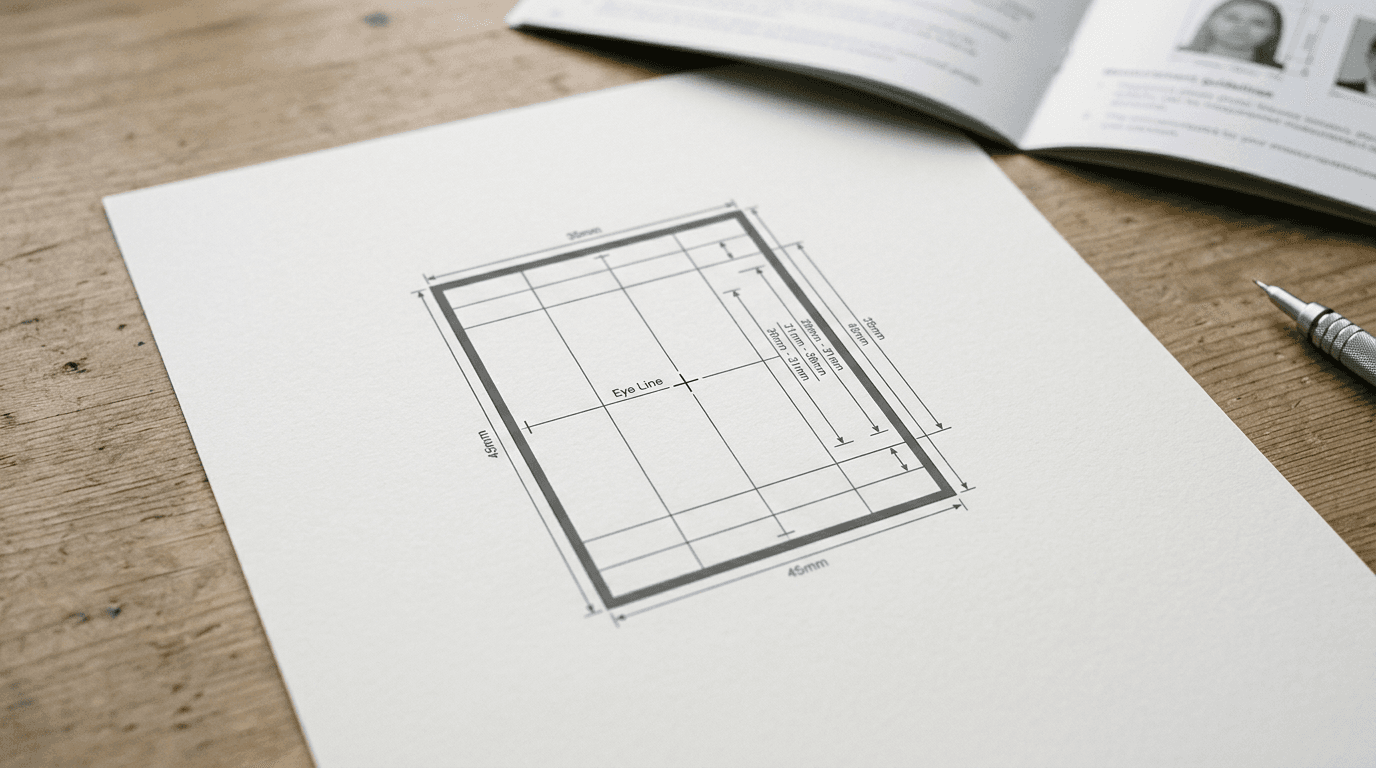
Photographing a newborn for an official travel document is an exercise in strict geometry, not portraiture. Parents attempting to meet UK passport photo requirements for an infant quickly discover that His Majesty's Passport Office (HMPO) evaluates these images using the same biometric algorithms applied to adults. The parameters leave zero margin for artistic interpretation: the distance from the chin to the crown of the head must fall exactly between 29 millimeters and 34 millimeters on a 35 by 45 millimeter canvas. A slight tilt of the head or a shadow cast by a supporting hand turns an otherwise clear photograph into an automatic rejection. Understanding the mechanics behind these biometric standards prevents the endless cycle of digital submissions and administrative delays.
Quick Summary
The UK requires passport photos to measure exactly 35x45 mm, set against a plain cream or light gray background, with strict biometric proportions. Meeting these parameters for infants involves controlling ambient light, ensuring open eyes (for older infants), and eliminating background shadows.
- Dimensions: 35 mm wide by 45 mm high.
- Head size: 29 mm to 34 mm from chin to crown.
- Background: Plain cream or light gray (not white).
- Resolution: Uncompressed digital files must be at least 50KB and no more than 10MB.
Table of Contents
- How the infant face defies biometric geometry
- Where home lighting ruins digital submissions
- The strict parameters of British biometric standards
- Why automated background removal fails infant hair
- What rejection codes actually mean for your application
- Comparison Table: Photography studio vs digital processing
- FAQ
- Recommended Reads
How the infant face defies biometric geometry
Biometric facial recognition relies on fixed points: the distance between the pupils, the width of the mouth, and the distance from the bottom of the chin to the crown of the head. An infant's facial structure changes these standard ratios. Their foreheads are proportionally larger, and their chins are often obscured by neck folds. This makes achieving the mandated 29-34 mm head size highly difficult without a precise understanding of where the chin actually ends and the neck begins. For those navigating the United Kingdom baby passport photo guide, the core challenge is isolating these biometric markers without the subject sitting unassisted.
When securing an online uk passport photo, the digital cropping tool assumes an adult neck. If an infant is lying on their back - the only approved posture for children under age one who cannot sit up - their chin tucks inward. The camera must be positioned exactly parallel to the infant's face, shooting directly down from above. Any angle introduces perspective distortion, artificially lengthening the nose and throwing the pupil-to-chin ratio out of tolerance.
Practical rule: Place the camera exactly parallel to the infant's face; if you tilt the lens to look down their nose, the biometric geometry will fail the automated scan.
Where home lighting ruins digital submissions
HMPO algorithms reject photos with uneven illumination because shadows obscure facial contours. A shadow across the cheek is interpreted as a physical deformity by the scanning software. Parents often position infants near windows, assuming natural light is optimal. However, window light is highly directional. It illuminates one side of the face while casting the other side into deep shadow, creating a contrast gradient that fails the exposure check.

To pass the system, lighting must be flat. This requires placing the infant in an environment where ambient light bounces off multiple surfaces. If shooting from above, the parent's body often blocks overhead lighting, casting a dark vignette over the infant's torso. Diffusing the light source or using two offset light sources minimizes these hard shadows. Those exploring United States baby passport photo guides will note similar lighting constraints, though background color requirements differ entirely.
The strict parameters of British biometric standards
British passport photo requirements demand a background color that is either plain cream or light gray. White is strictly forbidden. The reason is contrast: a pure white background frequently overexposes the edges of pale faces or light-colored hair, causing the automated cropping tool to misidentify where the head ends. The light gray or cream provides a baseline exposure value that helps the sensor lock onto the subject's outline.
Digital files must meet precise technical specifications. The final image must measure at least 600 pixels wide by 750 pixels tall, though HMPO recommends higher resolutions provided the file does not exceed 10MB. The file cannot be heavily compressed, as JPEG artifacts degrade the iris details necessary for verification. Utilizing an AI passport photo maker standardizes these digital outputs, ensuring the DPI and compression algorithms align with government expectations.
Why automated background removal fails infant hair
Many consumers rely on generic background removal software to replace a bedsheet with the required light gray tone. These algorithms are trained on adult hair, which has distinct, dense edges. Fine, wispy infant hair lacks a solid boundary. Standard edge-detection tools interpret fine hair as background noise, aggressively cropping it out. The result is a digitally altered silhouette that looks unnaturally sharp, which human reviewers at the passport office flag as "manipulated."
Any digital alteration of the facial features or head shape is grounds for immediate refusal. If replacing a background, the masking tool must operate at a pixel level, preserving the transparency of thin hair strands without leaving a halo of the original background color. For parents trying to determine the correct uk passport photo size, ensuring the masking does not artificially shrink the head's crown is vital for maintaining the 29-34 mm measurement.
Practical rule: Never use a generic portrait-mode blur or basic background eraser; if the software cuts into the infant's hairline, the photo is considered manipulated and will be rejected.
What rejection codes actually mean for your application
When a digital photo is rejected by the UK passport application portal, it provides a generalized error message. "Image too dark" rarely means the room lacked light; it usually indicates that the background was not light gray or cream, causing the camera to underexpose the face. "Subject not centered" often means the shoulders are missing from the crop, denying the algorithm a baseline to measure the head tilt.
Infants under one year old are exempt from the "eyes open" rule, but if the eyes are open, they must be looking at the camera without red-eye glare. Red-eye reduction software is considered photo manipulation. If a flash causes red-eye, the photo must be retaken without the flash. Reviewing the general guide repository clarifies these subtle distinctions across different age brackets.
Comparison Table: Photography studio vs digital processing
| Specification | Retail Photography Studio | Dedicated Digital Processing | Risk Factor |
|---|---|---|---|
| Environment | Unfamiliar, bright strobes, time-constrained | Home setting, natural ambient light control | High stress vs Low stress |
| Infant Support | Parent holds child (hands visible risks rejection) | Infant lies flat on light gray blanket | High risk of visible support |
| Background | Often default white, requiring digital alteration | Algorithmic replacement to exact hex code | Wrong color leads to refusal |
| Validation | Visual check by retail employee | API-level biometric pre-check | Human error vs Software precision |
| Recapture | Requires scheduling another visit | Immediate retakes at zero cost | Logistical delays |
Using specialized platforms often provides a safety net against compliance failures, especially when backed by a 100% refund policy tied to government acceptance.
FAQ
Can an infant have their eyes closed in a UK passport photo?
Yes, children under the age of one do not need to have their eyes open. However, if their eyes are open, they must be looking at the camera.
What color should the background be for a British passport photo?
It must be plain cream or light gray. Unlike many other countries, pure white backgrounds are not permitted and will result in rejection.
Are pacifiers allowed in the photo?
No. Dummies (pacifiers), toys, and other objects are strictly prohibited. The infant's face must be entirely clear of obstructions.
How much of the body needs to be visible?
The photograph should show a close-up of the head and shoulders. For infants lying down, ensure the framing captures the tops of the shoulders to provide proper scale.
Can a parent's hand be visible supporting the baby?
No. If any part of a parent or guardian - including fingers supporting the neck or head - is visible in the frame, the photo will be rejected.