Navigating Passport Photo for Visa Requirements Across Global Borders
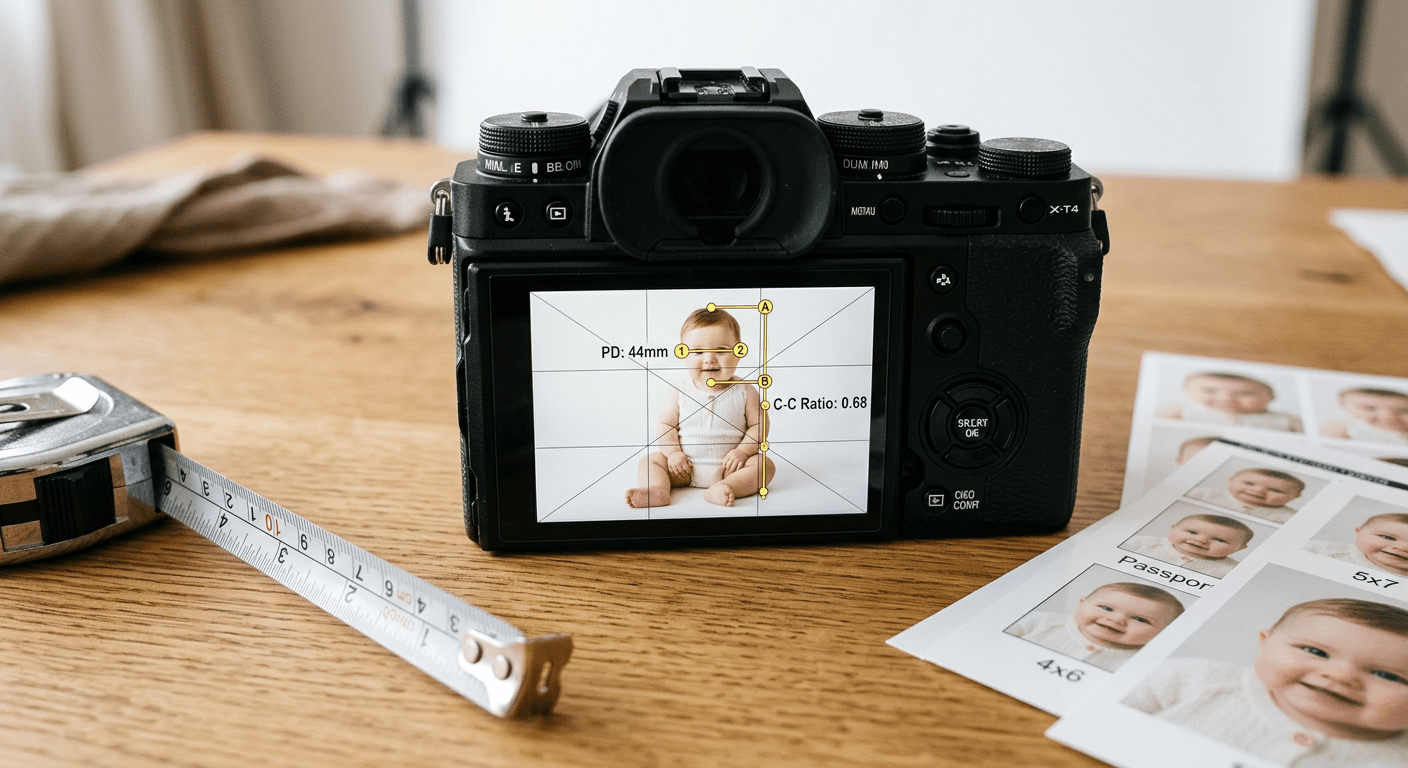
A common misconception among traveling parents is that a valid national passport photograph is universally accepted for foreign entry applications. Families frequently capture an image, successfully use it for an infant's domestic documentation, and later submit that exact same file for a European or Asian entry permit. Weeks later, the application is rejected. A standard picture guarantees compliance only for the issuing country's own passport book. A passport photo for visa processing is governed entirely by the destination country's biometric algorithms, which dictate everything from the millimeter height of an infant's chin to the exact hex code of the background color.
Foreign consulates do not evaluate images visually; they scan them through digital matrices designed to map facial landmarks. When you apply for international travel authorizations, the technical specifications shift significantly based on the region. Understanding the structural differences between these formats prevents the multi-week processing delays that occur when a physical print or digital upload fails a border agency's automated biometric check.
Quick Summary
A visa photograph is a biometric data point evaluated by foreign consulates against strict, country-specific geometric templates. While colloquially grouped together, visa image dimensions, background colors, and head-to-frame ratios vary sharply by destination.
- The United States requires a 51 x 51 mm square format.
- Schengen Area states mandate a 35 x 45 mm rectangular aspect ratio with an extreme facial zoom.
- China enforces a 33 x 48 mm size with stringent clothing contrast rules.
- Infant photography requires careful management of posture and background to satisfy automated consular scanners.
Table of Contents
- The Anatomy of a Biometric Visa Image
- US Visa Specifications and Infant Protocols
- Schengen Area Matrix and Sizing Guidelines
- China Visa Dimensions and Contrast Rules
- Three Invisible Failure Modes in Infant Visa Photos
- Global Dimensions Comparison Table
- Practical Capture Strategy for Multiple Formats
- FAQ
- Recommended Reads
The Anatomy of a Biometric Visa Image
The lens through which to view travel photography is the distinction between human aesthetic judgment and machine-readable biometric mapping. A standard portrait studio focuses on lighting and expression, but a border agency's software looks exclusively for geometric anchors. The distance between the pupils, the space from the bottom of the chin to the crown of the head, and the exact position of the face relative to the image borders constitute the biometric matrix.
When a consulate rejects an application, it is rarely because the subject is unrecognizable. Rejections happen because the automated scanners cannot find these anchor points where they expect them to be. The International Civil Aviation Organization (ICAO) provides a baseline set of rules for biometric imagery, but individual nations apply different crop margins and scaling ratios for their entry permits.
This distinction is critical for parents photographing infants. A baby's facial proportions change rapidly, and their inability to sit unassisted complicates the geometry. If a parent's supporting hand is visible, or if the baby's head lolls slightly to the side, the pupillary axis shifts off a strict horizontal line. The scanner will register a geometry error and auto-reject the file, regardless of how clear the face is.
US Visa Specifications and Infant Protocols
The United States Department of State operates on a strict square format. The required us visa passport photo size is 2 x 2 inches (51 x 51 mm). Within that square, the subject's head must measure between 1 and 1 3/8 inches (25 - 35 mm) from the bottom of the chin to the top of the hair.
The US matrix demands a pure white or off-white background with zero distracting elements. For adults and older children, the rules regarding neutral expressions and open eyes are rigid. However, the State Department provides specific allowances for infants. A newborn's eyes do not need to be fully open, and a slightly relaxed expression is accepted provided the baby's face is positioned directly toward the camera.
Achieving this geometry with an infant usually requires laying the baby on their back on a plain white sheet or draping a car seat with a white blanket. The challenge in the square format is ensuring the camera is perfectly parallel to the child's face. If you angle the lens downward from the baby's forehead, the resulting image distorts the jawline, shortening the chin-to-crown measurement and triggering a rejection. Referencing a dedicated United States Baby Passport Photo Guide helps clarify how to maintain this parallel alignment without casting shadows from your device onto the background.
Schengen Area Matrix and Sizing Guidelines
European consulates operate on a fundamentally different biometric template. The standard schengen visa passport photo requirements mandate a rectangular 35 x 45 mm dimension. The most critical distinction between the European system and the North American system is the head-to-frame ratio. Schengen states require the face to occupy 70 to 80 percent of the total photograph.
This translates to a chin-to-crown measurement of 32 to 36 mm within a 45 mm high frame. The resulting image feels aggressively cropped compared to a US format. There is very little space visible above the head or below the chin. When preparing a passport size photo for schengen visa applications, parents often make the mistake of leaving too much margin, which causes the biometric scanner to read the face as too small for facial recognition algorithms.
Furthermore, while the background must be plain, it should be light grey or very pale blue rather than pure white, especially for subjects with pale skin or white hair, to ensure the outline of the head remains sharply defined against the backdrop. Each European member state handles the exact background shade slightly differently; checking a specific country's documentation, like a Germany Baby Passport Photo Guide, reveals the subtle preferences that prevent processing delays.
China Visa Dimensions and Contrast Rules
The Chinese consulate enforces one of the most stringent and highly specific biometric matrices globally. The required china visa passport photo size is 33 x 48 mm, a narrow, tall rectangle. The internal geometry is strictly controlled: the head width must be precisely between 15 and 22 mm, and the head height between 28 and 33 mm.
Practical rule: If a country's specifications measure head width as well as head height, the camera must be positioned further back during capture to prevent the subtle