Understanding Chinese Passport Photo Requirements and Visa Sizing
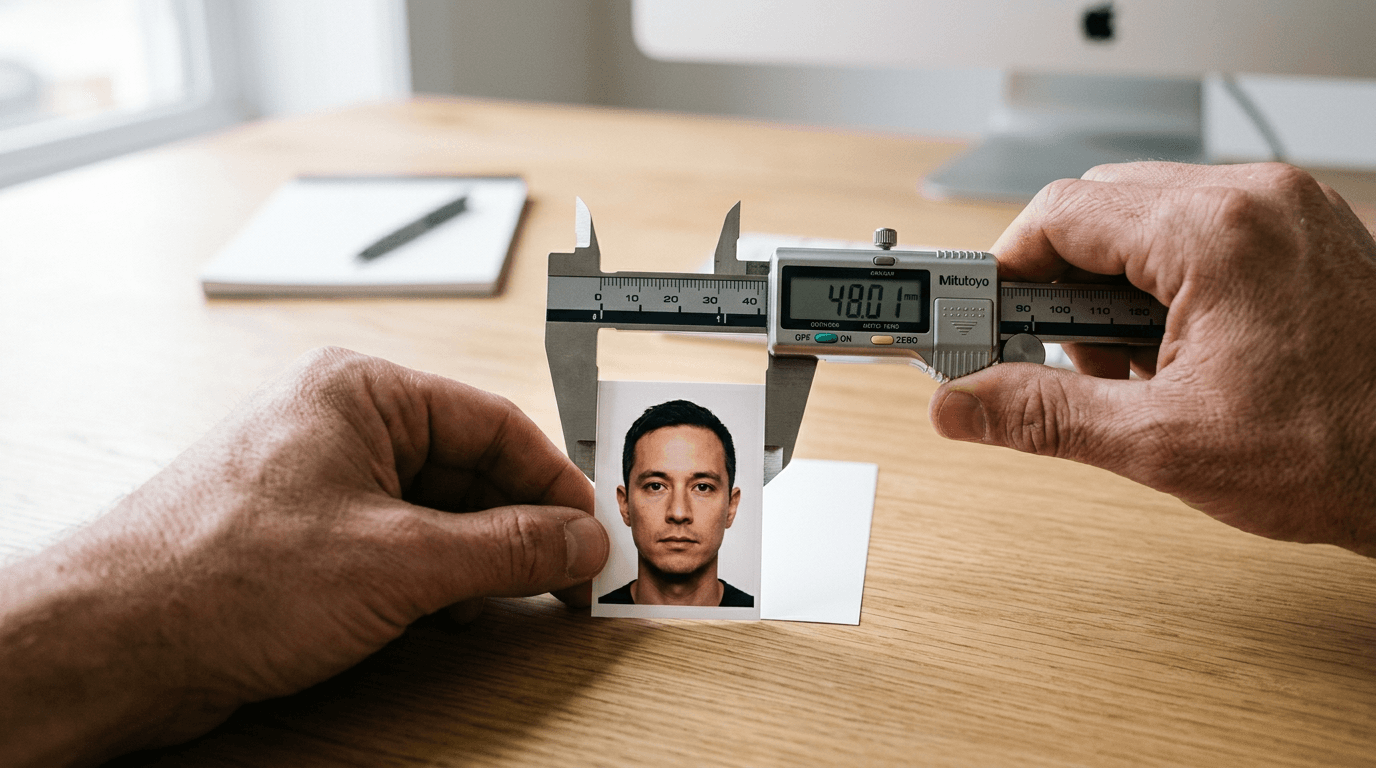
When you submit an application to a Chinese consulate, the digital photo validator is unforgiving. A soft shadow under the chin or a shirt collar that blends into the background will trigger an automatic rejection before a human officer ever reviews your paperwork. Meeting the strict Chinese passport photo requirements is the only way to avoid immediate application delays. The specifications differ significantly from standard North American or European formats, relying on a unique aspect ratio and millimeter-specific facial framing rules that standard pharmacy photo templates do not support.
Quick Summary
The Chinese consulate requires a highly specific photo format that prioritizes facial biometric scanning and strict dimensional accuracy over standard western photo sizes. Failing to meet the exact millimeter and pixel ratios will result in an immediate rejection by the online validation system.
- Physical dimensions: Photos must measure exactly 33mm wide by 48mm high.
- Head sizing: The head height must be between 28mm and 33mm from chin to crown.
- Background constraints: A pure white background is mandatory, with zero shadows or textures.
- Clothing contrast: Applicants must wear dark-colored clothing to contrast sharply against the white background.
- Digital specifications: Digital uploads require a minimum of 354 by 472 pixels with a file size between 40KB and 120KB.
Table of Contents
- The Exact Dimensions That Pass the Consulate Validator
- Why White Backgrounds Fail
- Clothing and Accessory Restrictions
- Infant and Toddler Exemptions
- Digital vs Physical Submissions
- Comparison Table: China Visa vs US Passport Specs
- The Three Most Common Rejection Codes
- FAQ
- Recommended Reads
The Exact Dimensions That Pass the Consulate Validator
The foundation of a successful application lies in the exact china passport photo size. Unlike the standard 2x2 inch (51x51mm) square used in North America, China uses a rectangular format measuring exactly 33mm in width and 48mm in height. Submitting a standard square photo and expecting the consulate officer to crop it for you is a guaranteed rejection path.

Inside that 33x48mm frame, the biometric proportions are strictly policed. The applicant's head width must measure between 15mm and 22mm. The head height, measured from the bottom of the chin to the top of the head (excluding hair volume), must sit strictly between 28mm and 33mm. This leaves very little room for framing errors. The space from the top of the head to the upper edge of the photo must be between 3mm and 5mm, while the space from the bottom of the chin to the lower edge of the photo must be no less than 7mm.
These millimeter-specific requirements mean that standard templates at local print shops often fail. When preparing your images, you must ensure the cropping tool you use explicitly supports the 33x48mm standard. If you are reviewing standard international baby passport photo requirements, you will notice that China's margins are among the tightest globally, requiring precise camera positioning.
Why White Backgrounds Fail
A "white background" is the most common reason for failure in the Chinese application system, primarily because applicants underestimate what "pure white" means to a machine vision validator. The Chinese system requires absolute white (RGB 255, 255, 255). Off-white, cream, light grey, or a white wall that appears grey due to poor room lighting will trigger an immediate rejection.
The mechanism of failure here is usually the shadow map. When a flash fires from a smartphone or a single light source is used in a room, it casts a hard drop shadow behind the applicant's head or shoulders. The biometric scanner reads this shadow as a structural anomaly or an invalid background gradient. Furthermore, ambient room lighting often causes a gradual falloff of light, meaning the background might be pure white on the left side of the frame but light grey on the right side. The validator measures uniform pixel brightness across the entire non-subject area.
Practical rule: Always position the subject at least two feet away from the background wall to allow light to spill behind them, eliminating the hard drop shadow that automated consular systems reject.
To pass the system, lighting must be flat and even. You need diffuse light hitting the applicant's face from the front, and separate light hitting the background to ensure it registers as pure white without blowing out the edges of the applicant's face or hair.
Clothing and Accessory Restrictions
The requirement for a pure white background dictates the clothing rules. Applicants are required to wear dark clothing that provides a hard, high-contrast edge against the background. Wearing a white shirt, a light grey sweater, or a pale blue blouse often causes the applicant's shoulders to blend into the background during the automated scanning process. If the validator cannot find the edge of the shoulder, it returns a framing error.
Glasses are a strict failure point for Chinese visas and passports. Even if the frames are thin and the lenses have zero glare, the current biometric standards heavily discourage them. Thick frames, tinted lenses, and glare are automatic rejections because they obscure the exact shape of the eye socket and the distance between the pupils, which are primary biometric anchor points. The safest approach is to remove all eyewear entirely.
Jewelry must also be removed. Necklaces, large earrings, and facial piercings can cast micro-shadows on the skin or create specular highlights (bright flashes of reflected light) that confuse the scanning software. Hair must be tucked behind the ears, completely exposing the forehead and the edges of the face. Heavy makeup that alters the natural contour of the face or skin tone is prohibited.
Infant and Toddler Exemptions
Photographing a newborn for travel documentation introduces distinct mechanical challenges. While adult applicants can easily sit straight and follow instructions, infants require physical support, which often introduces invalid elements into the frame. The china visa passport photo size and proportion rules still apply to babies, but the execution requires specific techniques.
The most critical rule for infant photos is that no other person or object may be visible in the frame. A parent's hand holding the baby's head, a visible car seat strap, or a pacifier will void the photo instantly. For newborns who cannot sit unassisted, the standard method is to lay the baby flat on their back on a plain, pure white bedsheet. The photographer must shoot directly from above, ensuring the camera plane is perfectly parallel to the baby's face to avoid perspective distortion.
Eyes must be open and looking directly at the camera lens. While some consulates are slightly lenient with newborns who struggle to keep both eyes fully wide open, the pupils must be clearly visible. Mouths should ideally be closed, but a relaxed, slightly open mouth on an infant is generally accepted if it does not distort the facial structure. If you are comparing this to the US baby passport photo guide, you will find the Chinese system is significantly less forgiving regarding head tilt and rotation.
Digital vs Physical Submissions
The Chinese consulate relies heavily on the COVA (Chinese Online Visa Application) system, which means applicants must master the digital specifications before worrying about physical prints. The digital file must be an RGB 24-bit true color JPEG format.
The pixel dimensions are strictly enforced. The absolute minimum resolution allowed by the upload portal is 354 pixels in width by 472 pixels in height. The maximum allowed is 420 pixels in width by 560 pixels in height. If you upload a massive 4000-pixel smartphone image without scaling it down properly, the COVA system's internal compression algorithm may severely distort the facial proportions or introduce artifacting that ruins the background purity.
File size must sit strictly between 40KB and 120KB. This is a very narrow window. Saving a high-quality JPEG often pushes the file over 120KB, prompting an upload error. Conversely, compressing the image too heavily to get under 120KB can cause the file to drop below 40KB or introduce blocky JPEG compression artifacts around the edges of the face, which the biometric scanner interprets as a failure of focus.
If physical prints are required for the specific consulate you are applying to, they must be printed on high-quality glossy photo paper. Matte paper is explicitly forbidden because its textured surface diffuses light and reduces the sharpness of the biometric features during the consulate's physical scanning process.
Comparison Table: China Visa vs US Passport Specs
Understanding the differences between systems helps clarify exactly why standard local photo services often fail for international applications.
| Specification | Chinese Passport/Visa | United States Passport |
|---|---|---|
| Overall Size | 33mm x 48mm | 2 x 2 inches (51mm x 51mm) |
| Head Height | 28mm - 33mm | 25mm - 35mm |
| Background | Pure White ONLY | White or Off-White |
| Clothing | Dark colors required | No strict color requirement |
| Digital Pixel Size | 354x472 to 420x560 | 600x600 minimum |
| File Size Limit | 40KB - 120KB | Up to 240KB |
The Three Most Common Rejection Codes
When the COVA system rejects an upload, it provides a generic error code that rarely explains the mechanical failure. Understanding what these errors actually mean allows you to troubleshoot the source file.
1. "Background not compliant or not pure white"
This failure occurs when the RGB values of the background pixels are not entirely uniform. Even if the background looks white to your eye, a smartphone camera might interpret the corners of the room as slightly darker. This is usually caused by relying on a wall that has texture, or by standing too close to the wall so the camera flash creates a hot spot directly behind the head while the edges fade to grey. The fix is to use artificial digital background removal tools to ensure the background is completely flattened to RGB 255,255,255.
2. "Face too dark or uneven lighting"
This happens when a strong light source comes from one side of the room (like a window). One side of the face is brightly lit, while the other side falls into shadow. The biometric scanner interprets the shadow as a different skin tone or a physical deformity. The fix is to face the window directly so the light washes evenly over both sides of the face simultaneously, eliminating the contrast ratio between the left and right cheeks.
3. "Proportions incorrect / Head too large"
The chinese passport photo size limits the head height to exactly 33mm. If the camera is placed too close to the subject, lens distortion (barrel distortion) causes the center of the face to bulge slightly, expanding the perceived head height. Even if the digital crop is technically correct, this distortion causes the facial features to spread. The fix is to move the camera back to at least four feet away, zoom in slightly to compress the perspective, and then crop the resulting image to the required dimensions.
Navigating these specifications requires precision and an understanding of how machine vision processes an image. The consulate does not care if it is a "good" photo of you; it cares exclusively whether the image maps perfectly to its biometric grid. If you are struggling with a complex application, exploring the help center can clarify formatting issues, and reviewing the Singapore baby passport photo guide provides a good comparison of how other strict Asian consulates handle biometric data.
FAQ
Can I wear my glasses if they have no glare?
No. The Chinese consulate strictly requires all applicants to remove their glasses, regardless of whether the lenses are anti-reflective or the frames are thin. Glasses obscure biometric anchor points around the eye sockets.
Can I use a standard 2x2 inch US passport photo for a Chinese visa?
No. A US 2x2 inch photo will be immediately rejected. The Chinese system requires a rectangular 33x48mm format with entirely different internal head-proportion measurements.
What color clothing is best for a Chinese passport photo?
You must wear dark-colored clothing (such as black, navy, or dark grey) to ensure a high-contrast boundary between your shoulders and the mandatory pure white background.
Can a newborn baby's eyes be closed in the photo?
No. Even for newborns, the eyes must be open and looking toward the camera. You may need to lay the infant on a white sheet and take the photo from above during a period when they are naturally awake.