Understanding Schengen Visa Passport Photo Requirements for 2026
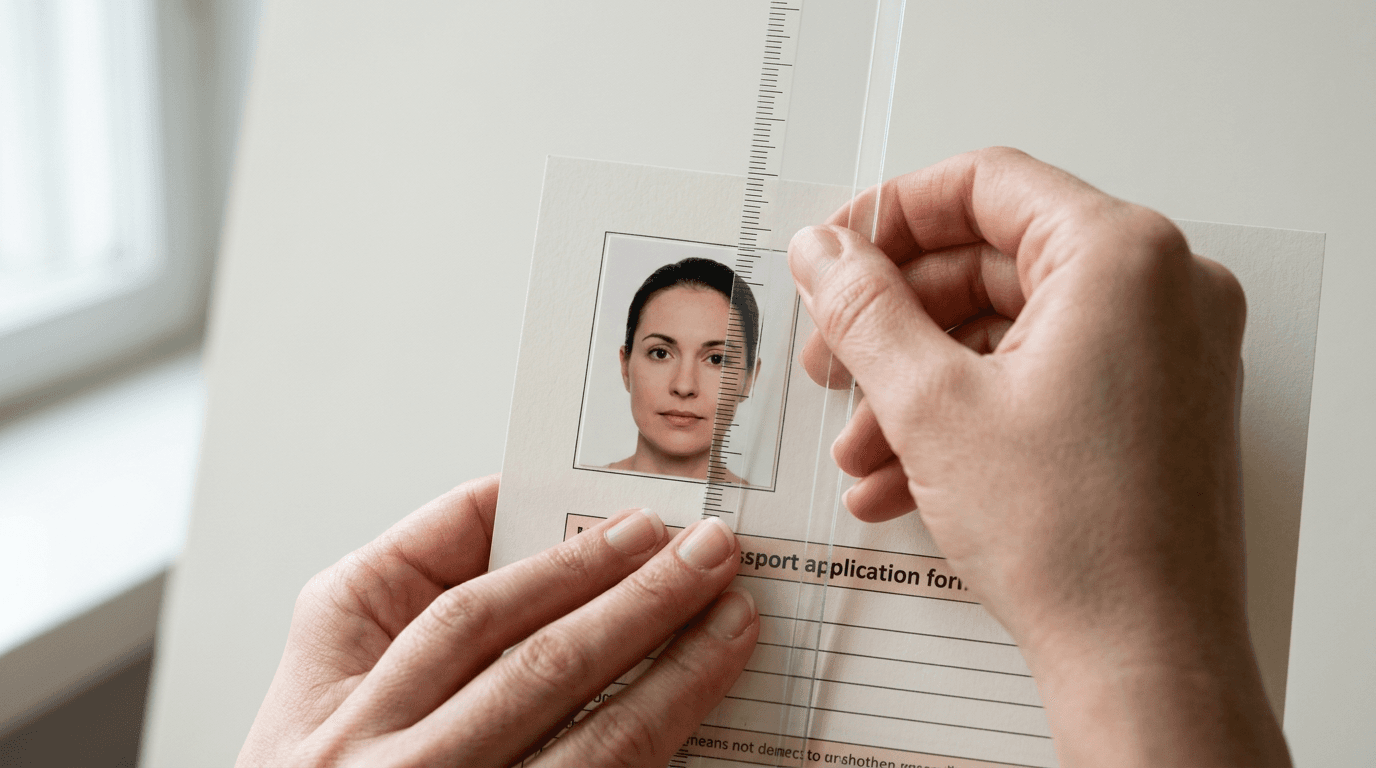
A common misconception among international travelers is that any official identification image will work across different global jurisdictions. Travelers routinely submit a standard two-by-two-inch print from a local pharmacy for a European application, assuming standardization, only to face an immediate processing delay. The strict schengen visa passport photo requirements are not merely suggestions about paper size; they are rigid geometric and biometric rules enforced by automated scanning software. Before submitting any application, you must understand exactly how the European border authorities measure, light, and validate facial geography.
Quick Summary
The biometric standards for European border entry dictate precise physical proportions, lighting conditions, and facial geometry that differ significantly from North American formats. A valid photograph requires strict adherence to International Civil Aviation Organization (ICAO) standards.
- Images must measure exactly 35 by 45 millimeters, not two by two inches.
- The applicant's face must occupy 70 to 80 percent of the vertical frame.
- Infant submissions require invisible head support and a shadow-free background.
- Automated biometric scanners reject images for uneven lighting or hidden anchor points like cheekbones or pupils.
Table of Contents
- Why the strict schengen visa passport photo requirements override local print dimensions
- How background lighting triggers automatic biometric rejections
- Where infant and newborn submissions fail most often
- What the biometric scanner actually maps on the face
- Evaluating your image generation methods
- When you must abandon an existing photograph
- FAQ
- Recommended Reads
Why the strict schengen visa passport photo requirements override local print dimensions
The fundamental disconnect for many North American applicants begins with the paper size. The United States standard dictates a 51 by 51 millimeter (2 by 2 inch) square. The European standard demands a vertical rectangle measuring exactly 35 by 45 millimeters.
You cannot simply take a United States standard image and cut the edges off to create a passport photo for schengen visa applications. The internal geometry breaks when you crop a larger square into a smaller rectangle. The primary mechanism of validation is the chin-to-crown ratio. In a valid European submission, the vertical distance from the bottom tip of the chin to the top of the head (excluding the volume of the hair) must measure strictly between 32 and 36 millimeters. This means the head itself dominates the frame, occupying between 70 and 80 percent of the total image height.
If you trim a wider photo down to 35 millimeters, the face either appears too small inside the remaining rectangle, or the crop cuts into the shoulders and hair, violating the centering rule. Furthermore, digital submissions must match these physical proportions in pixels. When uploading a digital file, the resolution must remain at 300 DPI (dots per inch), resulting in minimum dimensions of roughly 413 by 531 pixels.
To check your current photograph today, lay a physical ruler across the print. Measure from the lowest visible point of the chin up to where the skull would naturally curve at the top, ignoring hair spikes or curls. If that measurement falls below 32 millimeters, the automated intake system will flag the image for manual review, which frequently leads to an outright rejection. Understanding these exact international baby passport photo requirements prevents weeks of administrative delays.
How background lighting triggers automatic biometric rejections
Background colors and lighting setups are not aesthetic choices; they are functional requirements for edge detection algorithms. The rules mandate a plain white or very light grey background with absolutely no patterns, textures, or surrounding objects.
The mechanism at play here is contrast. The software scanning the photo must draw a clean, mathematical line between the jawline, the ears, the shoulders, and the background. If you stand too close to a wall with a single overhead light, your body casts a hard drop shadow behind your neck and shoulders. The scanner's algorithm reads that shadow as a structural extension of your body, inflating the calculated width of your neck or altering the shape of your jawline. This discrepancy between the mapped shape and human anatomy causes an immediate failure.
Directional lighting also causes facial rejection. Lighting a face solely from the left creates a shadow across the right side of the nose and right cheek. The biometric system uses symmetry to map the face. When one half is cast in shadow, the system cannot verify the anchor points on that side. You need flat, diffused, even lighting from the front.
Practical rule: Stand at least 1.5 to 2 feet away from the background wall to allow shadows to fall to the floor rather than the wall, and face a large window offering indirect daylight to ensure both sides of the face are evenly illuminated.
Checking this is straightforward. Look at the photograph and examine the space right behind the ears and right under the chin. If you see dark grey gradients spilling onto the background or down the neck, the lighting is too harsh.
Where infant and newborn submissions fail most often
Capturing an infant's image introduces massive physical limitations because the subject cannot stand, cannot support their own head, and cannot follow instructions to maintain a neutral expression. Yet, the geometric rules still apply. Parents frequently fail here by introducing their own hands or foreign objects into the frame to stabilize the child.
The mechanics of photographing an infant require an overhead approach. The most reliable method is laying the infant on their back on a flat, untextured white sheet. You then position the camera directly parallel to their face from above. The critical failure mode in this setup involves angle distortion. If the camera is tilted even slightly, it artificially extends the length of the chin or the forehead, distorting the 32 to 36 millimeter chin-to-crown requirement.
There are minor leniencies built into the rules for young children. While adults must look directly into the lens with a neutral expression and closed mouth, European authorities typically accept infant photos where the mouth is slightly open, and newborns under six months are generally permitted to have their eyes closed. However, toys, pacifiers, blanket textures, and supporting hands remain strict disqualifiers. Even a parent's finger visible at the edge of the shoulder will trigger a rejection.
Practical rule: If you must support an infant's head to keep it centered, place a rolled-up white towel beneath the white background sheet to form an invisible cradle, keeping your hands entirely out of the optical field.
For travelers navigating specific member states, referring to a localized Germany baby passport photo guide provides clarity, as Germany enforces some of the strictest interpretations of the infant ICAO standards in the European Union.
What the biometric scanner actually maps on the face
The instruction to maintain a "neutral expression" is not about looking serious for a government document. It is a strict geometric necessity. A biometric passport size photo for schengen visa processing is fed into software that calculates the exact millimeter distances between specific nodal points on your face.

The system maps the center of each pupil, the outer edges of the eyes, the tip of the nose, the corners of the mouth, and the highest point of the cheekbones. When you smile, your facial musculature shifts. The corners of the mouth pull outward and upward, the cheeks rise, and the eyes narrow. This alters the distance between your cheekbones and your pupils, invalidating the baseline map the border agent will later use to identify you in person.
Eyewear causes another common failure in this mapping process. While some jurisdictions technically permit prescription glasses if the frames do not obscure the eyes, the practical reality of modern scanning makes wearing glasses a high-risk choice. Any glare on the lens, no matter how slight, blinds the scanner to the pupil. Furthermore, thick frames cast micro-shadows directly onto the cheekbones, hiding the nodal points.
Before you submit the image, check the pupil-to-pupil line. Draw an imaginary horizontal line connecting the center point of both eyes. That line must sit exactly parallel to the top and bottom edges of the photograph. Even a five-degree head tilt throws off the entire coordinate grid.
Evaluating your image generation methods
Acquiring a compliant image means choosing between professional studios, automated pharmacy kiosks, and digital generation tools. Each mechanism carries different trade-offs regarding control over the final geometry and cost.
Local pharmacies and automated kiosks are calibrated for domestic standards. If you walk into a United States pharmacy, the automated die-cutter will punch out a 2 by 2 inch square by default. Requesting a 35 by 45 millimeter print often requires the operator to manually override the software, which frequently results in incorrect scaling.
Professional portrait studios offer complete control over lighting and dimensions, ensuring compliance, but they are expensive and require scheduling. For families with infants, booking a studio session adds significant friction to the process, as babies rarely cooperate on a set schedule.
Digital generation and AI platforms solve the scaling and background issues by taking a standard smartphone image, stripping the non-compliant background, and locking the facial geometry into the exact 35 by 45 millimeter crop required for Europe. The software validates the biometric ratios before generating a printable sheet. When evaluating these platforms, ensure the service backs its automated cropping with a 100% refund policy against government rejections, and verify they maintain a clear published privacy policy regarding how long they store biometric data.
| Generation Method | Dimensional Control | Biometric Validation | Risk of Rejection |
|---|---|---|---|
| Local Pharmacy Kiosk | Low (Defaults to US size) | Manual estimation | High if not manually adjusted |
| Professional Studio | High | Visual estimation | Low |
| Digital / AI Platform | High (Algorithmic cropping) | Automated mapping | Low |
When you must abandon an existing photograph
Reusing a photograph from a previous application is a common way applicants try to save time, but it frequently triggers administrative stops. The baseline rule states that the photograph must have been taken within the last six months.
The mechanism behind the six-month rule is physical change over time, but border agencies evaluate the appearance of change over the actual timeline. The six-month cutoff is the statutory maximum, not a guarantee of validity. If an applicant undergoes significant facial reconstruction, substantial weight loss or gain, or transitions genders within that six-month window, the old photograph is invalid immediately.
This is particularly critical for infant applications. The facial structure of a two-week-old newborn is fundamentally different from that of a five-month-old infant. The jaw widens, the skull solidifies, and the distance between the eyes shifts. If the infant in the photo does not geometrically match the infant crossing the border, the visa and the photo are effectively useless.
You can verify if your photo is too old by comparing it to your current reflection in harsh lighting. Do not look at hairstyle or beard length - border agencies ignore temporary styling. Look at the jawline structure and the visibility of the cheekbones. If those skeletal markers have visibly shifted, take a new photograph. If you run into formatting issues, consult a platform help center to verify the exact specifications for your target country before printing the final sheet.
FAQ
Can I smile in a passport photo for a Schengen visa?
No. You must maintain a strictly neutral expression with your mouth closed. Smiling shifts the physical location of your cheekbones and narrows your eyes, which breaks the geometric baseline that automated biometric scanners use to map your face.
Does my baby need their eyes open for the picture?
It depends on the child's exact age. Newborns and infants under six months are generally allowed to have their eyes closed or partially open, as authorities recognize the difficulty of posing them. However, children older than six months must have their eyes visibly open and looking at the lens.
What color should the background be for European applications?
The background must be plain white or a very light grey, with no patterns, textures, or shadows. A stark white background is universally accepted and provides the high contrast needed for edge-detection software to identify the borders of your face and shoulders.
Can I wear my prescription glasses in the photograph?
While technically allowed in some states if the frames do not obscure the eyes and there is absolutely no glare, you should always remove them. The risk of micro-reflections obscuring the pupil or frames casting shadows on the cheekbones makes glasses the leading cause of biometric validation failure.
Why can't I just crop a US 2x2 photo to fit the Schengen size?
Cropping a 2x2 inch square down to a 35x45 millimeter rectangle alters the internal proportions of the image. The Schengen standard requires the head to occupy 70 to 80 percent of the frame (a chin-to-crown height of 32 to 36 millimeters). Cropping a standard US photo usually leaves the face too large or too small for the strict European ratios.