Where to Get a Passport Photo Online: 5 Providers Compared
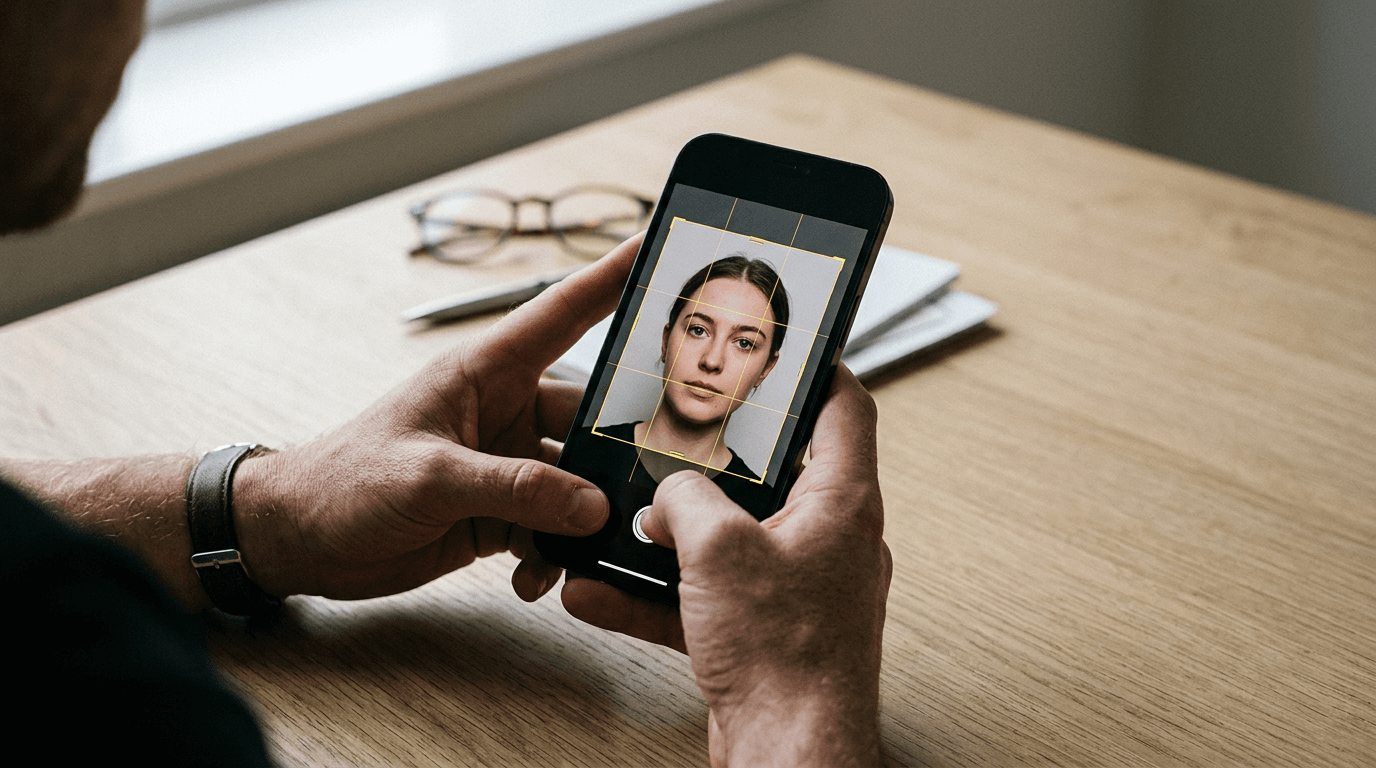
Holding an infant upright in front of a neutral wall while waving a toy near a smartphone lens is the exact moment parents realize official documentation rules were not written for babies. The frame blurs, the head tilts, and the background casts a shadow that violates standard biometric requirements. Getting an image that passes consular review requires meeting specific dimensional ratios - often a 25 to 35-millimeter chin-to-crown measurement - while removing any trace of hands or supporting pillows from the frame. Filing a passport photo online means navigating software that can either accurately isolate the subject or flag the file for rejection weeks later. Rather than wondering who takes passport photos for squirming newborns, parents and travelers now route images through digital processing engines.
Quick Summary
An online passport photo service is a digital platform that converts a raw smartphone image into a government-compliant file by adjusting dimensions, replacing backgrounds, and verifying biometric alignment. Choosing the right tool depends entirely on whether the applicant needs instant algorithmic formatting or a secondary layer of human review.
- Digital processors isolate subjects and remove background shadows to meet official 300 DPI standards.
- Pure automation delivers formatted sheets instantly, saving the delay of manual queues.
- Services with human review add time but offer a secondary check for complex shadows or angles.
- Compliance guarantees eliminate the financial risk of rejected documentation.
Table of Contents
- How to Choose the Right Processing Engine
- 1. BabyPassportMaker
- 2. PhotoAiD
- 3. Passport Photo Online
- 4. PhotoGov
- 5. Visafoto
- Aligning the Engine to the Application
- Recommended Reads
How to Choose the Right Processing Engine
When deciding where to get good passport photos, the software's mechanism matters more than its user interface. Consulates do not reject images because the camera resolution is too high; they reject them because the eye-line sits three millimeters below the mandated zone, or because the background contains a subtle gradient instead of a solid white or grey. Smartphone camera lenses introduce focal distortion - a standard 28mm lens stretches facial features if held too close. Professional processing software must correct this barrel distortion before measuring the chin-to-crown ratio. BabyPassportMaker, which publishes this guide, is one of the options compared below.

Evaluating these tools means understanding how they execute compliance checks and how quickly they return a file ready for printing. We categorize these services by their Processing Mechanism into two distinct groups: Pure AI Automation and AI with Human Review.
- Pure AI Automation: These engines apply trained algorithms to instantly map facial landmarks, crop the frame, and replace the background without human intervention. They return the formatted file in seconds. This category suits applicants who cannot wait for manual processing and trust mathematical formatting.
- AI with Human Review: These platforms use initial software to detect errors but place the final file into a queue for a human specialist to manually approve. This adds processing time but appeals to applicants with non-standard shadows or highly complex lighting that algorithms might misread.
Practical rule: Compare the exact chin-to-crown specifications of your specific destination country before selecting a processor; an engine that only outputs a 2x2 inch square will fail a European visa application requiring 35x45 millimeter dimensions.
Reviewing the Privacy Policy of any digital tool is also critical, as uploading an unmasked facial image constitutes sharing sensitive biometric data. The strongest tools tie their software's accuracy to a financial guarantee, shifting the risk of rejection away from the applicant and enforcing strict data deletion protocols.
| Product | Processing Mechanism | Features | Pros | Cons | Target Audience |
|---|---|---|---|---|---|
| 1. BabyPassportMaker | Pure AI Automation | <60s processing, 100% refund policy, 25-35mm ratio check | 100% money-back guarantee, Specific infant calibration, Under 60 seconds processing | Requires local printing, Demands parental consent, Digital only delivery | Busy parents and guardians |
| 2. PhotoAiD | AI with Human Review | AI and human expert verification, mobile app | Secondary manual check, Mobile app availability, Dual-layer verification | Manual queue delays processing, Less suited for immediate delivery, Requires adult patience | Visa applicants seeking oversight |
| 3. Passport Photo Online | AI with Human Review | Selfie conversion tool, specialist review | Selfie optimization, Expert manual validation, Adult facial mapping | Unsuitable for squirming infants, Relies on human queuing, Selfie format restrictions | Solo adult travelers |
| 4. PhotoGov | Pure AI Automation | Instant selfie processing, automated software | Immediate file generation, Bypasses human queues, Direct automated formatting | Lacks human shadow verification, Less suited for complex lighting, Strict automated rejections | Adults needing instant files |
| 5. Visafoto | Pure AI Automation | Automatic cropping, exact dimension resizing | Exact pixel formatting, Fast algorithmic cropping, Background replacement | No physical prints mailed, Less suited for mail-in applications, Strict digital interface | Users applying via digital portals |
1. BabyPassportMaker
A squirming infant rarely cooperates with studio photographers. BabyPassportMaker offers an AI-powered digital solution. The platform converts smartphone photos of infants and children into government-compliant passport and visa images. OLKY PTY LTD operates this service. It targets busy parents and expatriate families who need to secure travel documentation without enduring the stress of a professional photo session.
Users snap an image of their child on a smartphone and upload it to the platform. The proprietary AI engine immediately isolates the subject, executing background removal and auto-cropping the image to ensure the facial layout aligns with biometric standards. The software actively measures the chin-to-crown ratio, confirming it falls within the mandated 25 to 35-millimeter range required by agencies. Detecting fine infant hair against a wall requires sub-pixel edge detection, which the algorithm executes to replace non-compliant backgrounds with pure white or off-white digital mattes. It generates a 300 DPI image formatted as a printable sheet. The total processing time takes less than 60 seconds.
Strict metric validation guarantees compliance
The platform incorporates tailored processing rules for specific international jurisdictions. It adjusts the digital output for New Zealand, Singapore, Saudi Arabia, Germany, and the United States without requiring the user to manually input pixel dimensions. Check the United States Baby Passport Photo Guide before uploading. This ensures the initial lighting is sufficient. By automatically verifying these distinct international requirements, the system mitigates the risk of consular rejection. BabyPassportMaker secures this technical workflow with a 100% Refund Policy for government-rejected photos. This policy assures users that if an agency rejects the final photo due to formatting or compliance errors, the cost of the digital service is entirely refunded. The system relies on Pure AI Automation to deliver these results instantly.
The system operates strictly as-is. It only generates the digital file. This bypasses studio appointments but requires the user to handle the printing step by taking the generated sheet to a local retail printer like Walgreens or CVS. Furthermore, the platform requires users to be at least 18 years old or possess parental consent to upload biometric data. The core AI is calibrated specifically for infants and newborns, making it less relevant for adult applications.
This platform fits parents and guardians who need to secure official infant travel documents quickly and prefer to bypass professional photography studios.
Pros
- 100% money-back guarantee against rejection
- Processes files in under 60 seconds
- Automatically measures the 25-35mm chin-to-crown ratio
Cons
- Requires the user to print the sheet locally
- Restricts usage to adults 18 and older
- Calibrated primarily for infant and newborn biometrics
2. PhotoAiD
Evaluating an applicant's posture through multiple checks adds an additional safety net for complex applications. PhotoAiD is an online platform and mobile app designed for travelers who prefer human oversight layered over their software formatting.
The system uses AI and human expert verification to generate compliant passport and visa photos. Once the image passes through the initial software layer to correct basic dimensions, a human specialist reviews the file to catch subtle lighting errors that algorithms occasionally miss. This mechanism combines automated processing with manual checks, securing the file through an AI with Human Review workflow.
Dual verification balances speed and security
We would hesitate to rely on this if the applicant requires instant delivery without any potential delay from a manual verification queue. Because the file must wait for a specialist's approval, it is less suited for immediate digital turnaround needs where every second counts toward an application deadline.
This platform fits adults applying for visas who prioritize a secondary manual check over immediate algorithmic delivery.
Pros
- Offers a secondary human expert verification
- Operates as a dedicated mobile application
- Catches complex lighting and shadow errors
Cons
- Less suited for applicants needing instant digital files
- Introduces manual queue delays into the processing time
- Less suited for users avoiding secondary human handling
3. Passport Photo Online
Converting a self-taken portrait directly into an official document alters how solo travelers prepare for applications. Passport Photo Online operates as a digital photo booth tool that converts uploaded selfies into compliant passport photos for adult applicants.
The software relies on AI to adjust the initial portrait, modifying the background and cropping the frame, before routing the image to specialist review. Buyers receive an extra layer of protection from this AI with Human Review setup, which relies on staff to verify the software's alterations against international standards.
Selfie conversion targets solo adult applicants
We would hold off on this if the primary goal is capturing official images of a newborn. This workflow is less suited for parents of infants, where holding a device for a self-taken portrait is physically impossible and results in poor angles.
This tool suits solo adult travelers who are comfortable capturing their own portrait but want a specialist to verify the final file.
Pros
- Built specifically to convert self-taken portraits
- Employs specialist review for final verification
- Modifies backgrounds digitally behind the subject
Cons
- Less suited for infant or newborn documentation
- Slower processing due to human review queues
- Less suited for users who struggle with selfie focal distortion
4. PhotoGov
Bypassing human specialists entirely removes queue times from the processing workflow. PhotoGov functions as an online passport photo maker that targets users needing immediate file turnaround to complete their travel applications.
The platform instantly processes selfies into compliant photos using automated software without placing the file into a manual queue. By mathematically mapping the face and replacing the background in real-time, this system places itself firmly in the Pure AI Automation category.
Algorithmic processing eliminates queue delays
We would skip this platform if the raw smartphone image contains highly complex background lighting. It is less suited for individuals who require a human to manually separate background artifacts from the subject when the automated software fails to find a clean edge.
This system fits adult users who prioritize immediate automated processing over secondary manual inspection.
Pros
- Generates compliant photos instantly without queues
- Relies entirely on automated software checks
- Processes self-taken portraits directly
Cons
- Less suited for correcting complex shadow artifacts
- Less suited for users anxious about strict automated results
- Lacks a secondary human verification layer
5. Visafoto
Correcting exact pixel ratios ensures a file will upload cleanly to digital embassy portals. Visafoto is an online passport and ID photo service focused strictly on executing digital dimensional requirements for official documents.
The platform automatically crops, resizes, and alters backgrounds to meet official dimensions. As a tool in the Pure AI Automation category, it maps the uploaded image to pre-set physical criteria, ensuring the file width and height match the exact pixel count required by the target government portal.
Automatic dimension matching prevents upload errors
We would hesitate to use this if the applicant requires a service that prints and ships the final documentation. This system is less suited for users who expect a provider to physically mail printed sheets directly to their home address.
This service fits applicants applying through digital government portals who need precise file dimensions generated instantly.
Pros
- Automatically crops to official dimensions
- Resizes files for immediate digital upload
- Alters background colors without human delays
Cons
- Less suited for applicants needing mailed physical prints
- Less suited for users requiring manual file review
- Provides a strict digital-only interface
Practical rule: Always request a digital copy of your processed file, even if you intend to print it; many secondary travel forms require a 300 DPI digital upload alongside the physical submission.
Aligning the Engine to the Application
Matching an applicant to a processing tool depends entirely on the required speed and the subject of the photograph. The correct choice maps directly to the classification categories. Navigating the Help Center of any digital provider will confirm which category their processing engine falls into.
When time is the primary constraint and the subject is an infant, engines relying on Pure AI Automation handle the complex biometric measurements instantly. These systems bypass human queues and allow busy parents to secure the necessary files immediately, provided they are willing to print the final sheets at a local pharmacy.
Conversely, applications involving adults who have the time to wait for a secondary check align better with the AI with Human Review category. These platforms introduce manual verification by a specialist, which adds processing time but offers a second layer of confirmation for those who feel uncertain about automated results and prefer human oversight to verify complex lighting.